Showing posts with label Horror. Show all posts

Monday, December 21, 2015

#727: The Innocents

(Jack Clayton, 1961)

Much like its characters, The Innocents seems to exist between worlds; England and Hollywood; code cinema and modern authenticity; reserved mystery and psychological horror; proper literature and exploitative pulp; art film and studio product. It straddles these worlds in such a way that makes the film feel even more off-kilter and terrifying, underscoring the strengths of the story rather than weighing it down. It's certainly one of the most significant horror films in the Collection.

The movie is immediately surprising for a Fox film from 1961. It opens without any picture as a young girl sings a folk song without accompaniment. This continues even over the 20th Century Fox logo (rare enough for it to be striking) and leads into a brief shot of a woman praying before moving to the opening scene of the plot in which Kerr is hired as the governess. The opening sets the creepy, old-fashioned tone for the film but is largely forgotten until the song pops up again, and finally is explained as the end doubles back on the moment, leaving one to wonder how much of what's happened was a flashback, a dream, or a psychotic fictionalization of what happened.

The original story of Henry James's Turn of the Screw, on which the play was based that was then adapted into the film, is able to create a larger mystery because when the governess sees ghosts they are simply from her perspective. A film cannot show a ghost to a character without the viewer seeing it, unless the ghost is always offscreen, which even then would prove as suspicious as seeing the ghost is assuring. This means the mystery of whether of not the governess is a reliable narrator is deeper and the book is consequently more psychological. Still, there is something about Kerr here that feels off, and I don't think it's impossible to argue that her own actions are a bit unhinged, even if it is easier to take everything literally. In a way, the movie is more appealing if there are no ghosts, because the story of the evil couple that possessed the children is so puritanical and superstitious.

My favorite thing about the film was unquestionably the cinematography, and it's this aspect of the movie that makes the mystery richer. There's an explanation of why the film was shot with a blurred border in the Criterion set, but the end effect is satisfying on its own. The movie seems to exist in a beautiful fever dream, with the characters isolated from each other and reality. I thought of two Kubrick films while watching The Innocents. The first, The Shining, came up for obvious reasons - a woman stuck in an isolated giant building haunted by ghosts. But the film I was most reminded of was Barry Lyndon, another candlelit masterpiece with stunningly beautiful (albeit color) photography. Both films use their natural lighting to heighten reality and set the mood for the time period. The Innocents delivers candles that seem to create the photography on their own, resulting in the soft edges and mysterious glow of the film's nighttime scenes.

Although there were a handful of "creepy children" films before The Innocents, this is the oldest film I've seen that uses most of the elements of this subgenre in the modern way (children singing simple songs, music boxes, possessions, creepy dialogue that has multiple meanings, etc). This doesn't necessarily make it a better film (though all of these elements are executed better than in most subsequent films) but it does help its case as an important step in the evolution of horror.

If I was going to hesitate to canonize The Innocents (and I am), it would be because of the somewhat creaky plot machinations of Kerr's character. It's not entirely clear why her character seems to know with great certainty every step needed to free the children of her curse - though of course this makes the case for her insanity - and the way she goes about explaining it all to Mrs. Grose is the kind of exposition that hurts the film rather than helping the viewer. Kerr's performance is difficult to pick apart considering it was done in 1961, but she can occasionally come across as inauthentic and dated in today's eyes, something I've always thought about her and was hoping to avoid with this performance. That said, these are minor quibbles that do not overshadow the remarkable accomplishments of The Innocents, and it's worth underscoring just how vital the film feels to modern horror and supernatural filmmaking. I'd put it on the shortlist for any director interested in learning more about horror technique, and I look forward to watching it again to see how it's all put together.

One other interesting note about The Innocents: I decided to watch this now basically at random - it was the next film by spine that I don't own and isn't on Hulu - unaware that it was written by Truman Capote. Of course, In Cold Blood was just released in the past few months and covered by David Blakeslee over at Criterion Reflections, where I expressed mixed feelings about that much more famous and based-on-a-true-story thriller. Interestingly, Capote wrote the script for The Innocents while researching In Cold Blood, further tying the two to each other. Putting The Innocents in this context might make my positive response to a movie that ends (spoiler alert) with a dead child seem a bit hypocritical (despite the obvious excuse that the film is purely fictional). But I think it's important to put the entertainment value of horror in the context of the themes its intending to explore and expose for the viewer.

Wednesday, November 30, 2011

#579: The Phantom Carriage

(Victor Sjöström, 1921)

Taken at face value, the villain in The Phantom Carriage is the drink. This was exploited when the film came to America (during Prohibition no less!) but it does not especially seem to be the intention of the film - alcohol is a means to an end both for the drunkard at the center of the story and the story itself, which seems to owe a great deal to A Christmas Carol.

The myth at the center of the film - the last person to die on New Year's Eve must take over as Death for the following year, with each day feeling like 100 years - has timeless appeal and could easily feature as the center of a modern horror film. But the film is actually more about a man being shown the light and changing his wicked ways. As a result, there wasn't much here I could become invested in on a narrative level.

Technically, however, The Phantom Carriage is an immensely impressive silent film. Sjöström uses multiple exposures to get his ghosts just right, and he pops back and forth in time in an impressive fashion. The horror-style scenes - of which there are few - are shot well, and if it hadn't been ruined for me, the clear influence the film had on The Shining would have been a pleasant surprise. While it's not one of my favorite silent films I've ever seen, The Phantom Carriage makes a solid case for early cinema as a major treasure trove of ideas and techniques that is essential to understanding not just early talkies but the modern film landscape. For this reason, it's a worthy successor to Nanook of the North as the oldest film in the Criterion Collection.

Friday, November 25, 2011

#352: Jigoku

(Nobuo Nakagawa, 1960)

I just wish more of the characters in this movie died.

So Jigoku is a dark movie, a fable divided into two halves. The first is set in the real world, though the characters seem like they are walking through a dream (and the production design is oddly minimalist - in a good way). The second half is in the titular Hell, and it's here where the movie makes its reputation. This Hell is an abstract nightmare-scape. Its inhabitants move zombified through a swirling infinity that weirdly reminded me of Solaris - though that film's visuals owe much more to the divine than the damned. Jigoku is a fairly terrifying movie, full of gore and ghosts, even if the moral lesson of the first half has already been beaten over your head before the protagonist's real punishment is doled out in the second.

Despite the visual appeal of the movie, I was left somewhat cold by the philosophy behind it. Perhaps I would have preferred a more realistic in-depth look at the self-guilt that surrounded the first half, or a more expansive look at the nature of spiritual punishment from the second; maybe I just didn't want both in the same movie. After The Flowers of St. Francis, a gentle look at religion made a decade earlier half a world away which I watched right before this film, Jigoku seems almost silly, a naïve case for scaring people into the righteous path. Personally, I don't get it - why would acting like a good person because you don't want to burn in Hell for all eternity make you a good person? Doesn't that just make you a prisoner?

Anyway, some cool gore in this one and it did make me have a nightmare, which is pretty impressive.

Monday, August 22, 2011

#467: Empire of Passion

(Nagisa Oshima, 1978)

Empire of Passion was titled in its original Japanese In the Realm of Passion, a strong indication of how much Oshima grouped this film in with its controversial predecessor, the deeply affecting and sexually explicit In the Realm of the Senses. It's wholly unnecessary: Empire of Passion stands on its own, every bit as beautifully haunting as its predecessor - it might even be the superior film.

Oshima's twin masterpieces were bankrolled partially by French backers almost certainly because they were erotic thrillers, with an assumed emphasis on erotic. If Oshima had made Empire of Passion first, there's little doubt his bankers would not have let him make In the Realm of the Senses. Where the latter film flirted dangerously with twisted erotica for pornography's sake, Empire of Passion cannot be mistaken for anything but what it is - a horror film (with a touch of noir) in the Japanese ghost tradition that delivers themes of morality, guilt, and, yes, passion. If you looked up macabre in the dictionary, it wouldn't be too surprising to see a little mpeg of this film waiting for you.

Despite the film's gripping story, Oshima's visuals are the dominating force. This movie is fucking gorgeous. Shot by Yoshio Miyajima (who worked on much of Masaki Kobayashi's best work, including Harakiri), there is an eerie glow to everything here. Oshima uses backlighting and twilight impeccably - seriously, I want to rewatch the movie right now just thinking about it. It's a shame Criterion has only released In the Realm of the Senses on Blu-ray, as this is an equally worthy candidate for the higher-resolution format.

The big question (assuming you like silly artistic comparisons as much I do) would be which of the two films is better? I'm not surprised In the Realm of the Senses is the most famous Oshima film. It's clearly the more shocking and rebellious one. Likewise, Empire of Passion is more easily accessible. I don't know that I can think of more than a handful of people I'd feel comfortable recommending the earlier film to, while Empire of Passion would be well-received by a broader audience. Of course, I enjoyed the latter more, while I think In the Realm of the Senses is of more consequence. Ultimately, I'll just say I am happy to have seen both films and leave it at that. Oshima is one of the more iconoclastic filmmakers in the collection, and his twin masterpieces represent some of the most interesting viewing the collection has to offer.

Tuesday, August 16, 2011

#584: Kuroneko

(Kaneto Shindo, 1968)

For the average Criterion nerd, Kuroneko will forever be associated with House, the other Japanese cult horror film that served as the other half of a double feature that played throughout the country before both films were released on DVD. This is an extremely misleading connection, however, and it makes for very misguided expectations when going into Kuroneko. Beyond these superficial connections, the films share very little in common. This is not a wild psychedelic journey tapped into Japanese pop culture overload.

In fact, the film which is most obviously akin to this much more somber, infinitely more haunting mood piece is Shindo's earlier horror film Onibaba. Both films deal with a mother and daughter who murder samurai during wartime. Each has their astounding moments, though Onibaba has one foot in the erotic thriller camp, while Kuroneko is very much a ghost story.

Regardless of its place in Japanese film, Kuroneko is a worthy revival for the collection, a unique take on the samurai movie that incorporates issues of morality and revenge into a tragic whole. Unlike Onibaba - which relied on sparse music to enhance impact - this later film avoids music in its most intense and supernatural moments. It makes the presence of death weigh over the film's story, which begins and ends with its main characters meeting their fate. Kuroneko is ultimately more sad than it is scary, but that doesn't take away from the effectiveness of the film. Thankfully, Kuroneko isn't meant to live up to House by its association (what movie could?) but instead demonstrates the wide range of Japanese horror - both are strong reminders that the genre had roots in the East far before Ringu kicked off a revival.

Wednesday, July 20, 2011

#338: Equinox

(Jack Woods, 1970)

Is there anything worse than computer generated effects? There was a time when special effects were all about cleverness and extreme creativity. With computers, artistry has become craft and no one asks "How did they do that?" anymore because everyone knows the answer. The biggest victim of this technological shift is spectacle (did anyone care about the mass of ships that were clearly easily duplicated in Troy?) but creature design  - with a few exceptions - has taken a real hit, since everything is drawn instead of crafted these days.

Of the old masters pre-CGI, Dennis Muren was one of the greats, most famous for his work on Star Wars. This early entry in his catalog, however, is extremely entertaining. It's an homage to the creature features of the 1950s about a group of kids that get caught up in a mystical battle for control of secret evil powers. The production value is very low, the acting only moderately passable, and the story alternates between overused tropes and campy cheese. But it's all saved by the straight-faced delivery and Muren's gloriously inventive effects, especially the monster designs. This is one of the more unusual entries in the Collection, but it's a welcomed one.

Thursday, June 16, 2011

#539: House

(Nobuhiko Obayashi, 1977)

House is undoubtedly one of the strangest movies you will ever see. It's also not coincidentally one of the most invigorating from a filmmaking perspective - there are moments here that are so filled with energy and ideas that it reminded me of when I was a kid and I would watch NBA playoff games and get so invested in the sport that I would have to go outside and play myself. House made me want to go into my backyard and make a movie - whatever movie I could, pulled together with camcorders and borrowed friends - and pour my whole being into it.

The plot of the movie would hardly qualify for an episode of The Twilight Zone. A group of teen girls has their vacation canceled, so one of them arranges for the group to visit her dead mother's older sister, whom she hasn't seen in years. As in most movies with a smiling ghost cat on the cover, things don't go as planned. The simple structure, however, is essential when a movie is this insane - there would just be no other way of following along with what's happening once pianos start eating people.

Even in the relatively calm beginning the film establishes its anarchic tone and then rarely lets up. Oddly, parts of the movie reminded me of Godard's A Woman is a Women, particularly moments that seemed more concerned with topical cool than rewarding plot development. But the movie that most came to mind was the comparatively tame Run, Lola, Run, which rode a similar crest of energy and style to international success a decade ago. Both movies have a certain music video aesthetic (though, of course, House was released before music videos became ubiquitous and developed the language we currently identify with the genre) and both films take simple stories and build something extraordinary out of them.  The most notable differences then can be attributed to the general sensibilities of their respective cultures, which in the case of House takes shape as a giant explosion of pop grotesqueries.

Perhaps the most amazing thing about House is that it was a commercial success in Japan. I don't know what that says about Japan, but the idea of a film this strange being successful in the US with anything other than the cult audience that has received it with open arms is almost entirely implausible. Still, the film is so strange, so idiosyncratic, so, well, itself that it refuses to be ignored. House is one step away from a giant disaster in every direction, and yet it is so infused with an unrestrained love of filmmaking that it walks the tightrope beautifully.

Saturday, April 16, 2011

#27: Flesh for Frankenstein

(Paul Morrissey, 1973)
While it isn't quite as successful as its follow-up, Blood for Dracula, Paul Morrissey's Flesh for Frankenstein is still an immensely good time at the movies. Udo Kier once again gives a great, hammy performance, this time as Baron Frankenstein, determined to construct a master Serbian race of zombies bowing to his every whim. As would be expected, there's plenty of sex and gore, all purposefully over the top at the service of Morrissey's sharp satirical take on modern life.

The film's campy pleasures take on another dimension - the third to be precise (cheesy joke ftw). I wouldn't blame the unsuspecting viewer of this DVD to be confused by the random shots of people holding things out to the camera, culminating in an impaled organ at the end of a pole. Knowing the film was intended to be shown in 3D makes these moments possibly more enjoyable than they were in theaters - 3D was so terrible in the 70s that the pleasure of watching people act strangely in order to deliver an effect that never comes is truly amusing.

Elsewhere, the film fails to lift off plot-wise in the clever way its successor does. It's easy to see the whole story coming from a mile away, and the film's final moments - much like the preceding hour - are more appealing for their campy gore than the Hamlet-like finish. Still Flesh for Frankenstein isn't about the characters or story, and it's hard to fault a film for delivering just what it sets out to do. Morrissey's take on the monster story remains totally original and unique, and - though they are currently out of print so Image could put out mediocre releases of their own - both films are deserving of their place in the collection.

Tuesday, December 14, 2010

#364: Monsters and Madmen

(Robert Day and Spencer G. Bennet, 1958-1959)

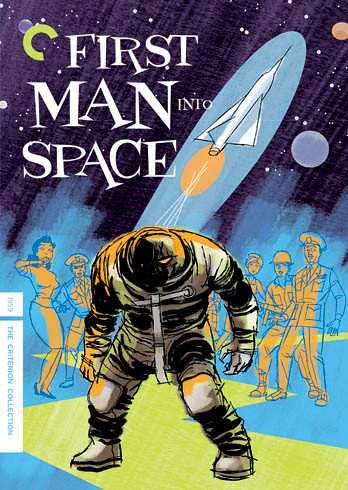
Monsters and Madmen is an unusual but welcome addition to the collection. It is a solid representation of a very specific kind of film from a very specific era in film history. While many of the movies from this era have become extremely campy with passing time, even the rudimentary effects of The Atomic Submarine and the ridiculous costume in First Man into Space are easy to ignore because you are invested in the story and more amazed by the filmmakers' sheer (perhaps misguided) confidence to pull it off.

Of the four films, I enjoyed Bennet's more than Day's three. Not only did The Atomic Submarine have the most enjoyable effects, the best lines, and some of the more interesting philosophical underpinnings, it was also for me the most fun by far. I loved the alien, whose look recalled The Simpsons and intentions recalled The Twilight Zone. I loved the ship, one of the most obvious models I've ever seen in a film, the kind of effect that makes you think Ed Wood wasn't so off the mark. Mostly, though, I loved the score, which was futurism at its wackiest.

Then there's The Haunted Strangler, which I actually think could be remade with a few tweaks to make the reveal a bit more believable. In fact, Karloff's performances in that film and Corridors of Blood helped carry the movies. The only one I didn't really like First Man into Space, most likely because the threat seems so unlikely to us now (the film was dated in just a few years). Still, a great collection, and while it's not the ideal set for me, it's the kind of thing that probably changed the lives of a few fellow nerds out there.

Links to individual reviews:

First Man into Space
The Atomic Submarine
The Haunted Strangler
Corridors of Blood

#367: The Haunted Strangler

(Robert Day, 1958)

 The Haunted Strangler has basically the exact same plot structure as Corridors of Blood. Boris Karloff plays a well-intentioned, well-respected man in the 1800s who is searching for a solution to a common problem and unwittingly becomes the villain. He has a younger protégé who is romantically involved with his younger relative in both, and both end in tragic finales.

On the other hand, The Haunted Strangler has a much more appealing concept behind it. Karloff is searching for a man who may have been the real killer in a serial spree twenty years earlier... though of course there's more to it than that. Karloff, for his part, gets to do some really great over the top physical work here, and the movie is a memorable one (and not just because the final victim in the initial spree was Martha Stewart!). Ultimately, though, these are the kind of movies that are more pleasurable than anything else, worthy distractions from more serious weighty topics (see the last month of Bergman viewings). I enjoyed it more than Corridors of Blood, but the genre itself fails to grab me beyond basic entertainment.

Saturday, November 20, 2010

#365: First Man into Space

(Robert Day, 1959)

First Man into Space is one of the movies in the collection that is included not because it is great or especially relevant, but because it is not exceptional. Sure, it's made with a certain indefinable confidence, born not out of ambition but out of love for film. And yes, it is really astonishing that the filmmakers were able to pull off a fairly believable (if you ignore the now-cheesy slow-moving monster) sci-fi thriller with what probably amounted to a couple thousand dollars in finds. But there have been so many movies like First Man into Space made over the years that it's hard to really get excited about it. Finally, the movie is a bit of a drag, as it doesn't really get going until about an hour in (the movie is less than 90 minutes long) and you never really care that much about any of the characters.

When people talk about movies like First Man into Space, they often speak of the genre as a dead one, first made popular in the 1950s and dying out somewhere around the early 80s when Hollywood tightened up the distribution racket and films got more and more expensive to produce (especially films like this when audiences began to demand more and more sophisticated effects). But taking a look at recent sci-fi fare reveals that there are still movies being made in a somewhat similar fashion - the recent dud Skyline is a solid example of this. This makes films like First Man into Space interesting viewing for anyone who loves film history, but it doesn't improve their quality.

I'll freely admit I am not the audience for this kind of movie. The closest I probably come to loving a film like this would be either John Carpenter's remake The Thing or Brad Bird's homage The Iron Giant. But I can't imagine kids who would love a film like Skyline or something like the recent not-totally-terrible Pandorum would be able to sit through this movie, which is dated by its glacial plot and focus on morality tales in the name of pioneering science. It's not the special effects in the film that seem most dated, it's the style of entertainment.

Sunday, September 26, 2010

#368: Corridors of Blood

(Robert Day, 1959)

Not too much blood in the corridors here, but instead a rather surprisingly smart and taut thriller/drama about a good doctor in the 19th century before the invention of anesthesia gone crazy with a mad (but with our hindsight very realistic) quest to find a cure for pain during surgery. I have to admit I kept hoping for a little bit more awesomeness as the film careened towards its inevitably tragic conclusion. However, the fact that I was dreading this awesomeness is a testament to how much affection I began to feel towards Boris Karloff's character. This is a true testament to the film's ability to generate strong drama far beyond what I would have expected based on the packaging Criterion provides here, which is truly amazing but I feel does somewhat of a disservice to the film within.

Friday, July 16, 2010

#231: The Testament of Dr. Mabuse

(Fritz Lang, 1933)

This is a pretty dark movie. I guess I shouldn't be surprised, coming from Lang, who made two of the great films of early cinema, Metropolis and M (which was just re-released by Criterion on Blu Ray). But even with this pedigree, the movie was shockingly nihilistic, terrifying, and experimental. Considering the fact that it was made in 1933, the use of sound is strikingly effective, not just for talking but for psychological impact. And the super-imposed images of ghosts and specters are extremely effective.

The film isn't as spectacular as M (few are) but it does have social relevance: it was made during the rise of Hitler in Germany, and has the distinction of being the first film banned by the Nazis. Lang (who, like Hitler, was actually Austrian) saw the writing on the wall and left the country soon after, eventually making his way to America, where his most notable film was probably the noirish The Big Heat. But he never reclaimed the vanguard position he had early in his career with films like this one.

Tuesday, March 30, 2010

#28: Blood For Dracula

(Paul Morrissey, 1974)

I shouldn't have put off watching this for so long, but something about it made me think it was going to be more boring than anything else. Maybe it was the films actually made by Andy Warhol, such as New York and Blow Job, which are art pieces meant to be viewed in context rather than focused on for their entire running lengths. Regardless, when viewed with the goals of the film in mind, Blood for Dracula is a complete triumph, from the awkward pacing of the dialogue to the clumsy socialist rhetoric that is tossed around by the mysteriously American-sounding Italian villa worker/hero, whose most heroic moment comes in the form of a rape.

I have mixed feelings about cult films, and on the whole, I think there are as many cult films of value, proportionally speaking, as there are films of value in general. But unlike, say, Reefer Madness, Blood for Dracula is a movie that was obviously made with this designation in mind, yet it never collapses under the weight of self-parody. Fronting De Sica and Polanski as he tramples on both director's respective genres, Morrissey is nothing if he isn't tongue in cheek, consistently reaching for both entertainment and a vicious sense of satire. The film ends up being wicked fun, and deserves a higher profile than it has.

Friday, January 8, 2010

#226: Onibaba

(Kaneto Shindo, 1964)

When I would make a beeline for the Criterion section at a DVD rental or retail store, Onibaba always had one of the more striking covers. What's going on there? It had echoes of Kabuki, but a more sinister feel. When I saw Kwaidan a few years ago - which I loved - Onibaba came up in a few threads about the film, but I never made the plunge until today. The visuals can't hold a candle to that film, but then again this is a very different kind of movie, a gritty tale of demons and murder and boobs. The ending is so abrupt and oddly terrifying that I was tempted to redeem the whole film, which had been good, but not great. Upon reflection, it didn't save a movie that had brief moments of brilliance, but seems merely adequate among giants.

Thursday, December 10, 2009

#437: Vampyr


(Carl Dreyer, 1932)

When it comes to silent films (or in this case, mostly silent), I am very opinionated, and I generally find that if I like a director, I'm going to like the film. I like every Fritz Lang movie I've seen. I love every Buster Keaton movie I've seen. And I worship every Tod Browning movie I've ever seen. I know it's heresy, but I just don't care for Dreyer, both silent and not. I was hoping I would have a different response to this one, both because it is a vampire movie - so different from his other movies - and because I had heard really good things about it. But it just didn't do it for me. I enjoyed a few of the more atmospheric moments at the end, but overall I'm pretty much done with this one. Anyone have any insight on why I should think about this one again?