Showing posts with label 001-025. Show all posts

Saturday, February 23, 2013

#17: Salò

(Pier Paolo Pasolini, 1975)

There is a truly harrowing moment in Salo, but it's not any of the moments often cited as difficult to watch. Unlike those scenes, it doesn't involve excrement, knives, or gruesome torture. Instead, a handful of victims is found to be in violation of the rules and, rather than deal with their inevitable punishment, they rat out other victims for breaking the rules. They do this even most likely fully aware that it will not save them, but in a last ditch attempt to have power over someone else in the way they themselves have already been dominated.

Salò is undoubtedly the most notorious film in the Criterion Collection, and arguably the most notorious film made by a serious filmmaker in the history of cinema. Watching the film is a rite of passage into that most daring (and insignificant) group of cineastes who are willing to go the extra mile to satisfy the urge to complete their cinematic education. It's also sought-out by viewers with a thirst for the extreme, those who would group it in with The Human Centipede and Cannibal Holocaust as a graphic ordeal that is unafraid to explore the limits of exploitation and extreme violence.

Though I understand the latter group, I generally reject the appeal of that sort of movie, so, apart from simply wanting to have a fully finished list of Criterion movies with no cheating, any desire I would have to see the film would stem from my allegiance to the former group. Either way, I think both groups would and should be dissatisfied with Salò. As a film, I don't think it's especially impressive, and as a piece of horror-slanted torture porn, it's rather awkward. Salò neither delivers a compelling political or cinematic case for its existence, nor treats its most disgusting and shocking moments with enough reckless abandon for horror fans to enjoy it. The lack of story, the disappointing way in which homosexuality is treated (especially infuriating since Pasolini himself was gay), and the thin line between the horrors of fascism being exposed and the thrill of fascism being glorified makes the film a somewhat meaningless viewing.

Still, the enormous reputation of the film, combined with my own long journey toward viewing it (or even being ready to view it) seems to demand an evaluation. Like so many visceral films, Salò must be evaluated on two separate levels: the experience of watching it, and what is actually on the screen. Pasolini's most beautiful shots (essentially all of which come in the first half of the film) can not conceal the emotional dread this beauty invokes simply because we know what's going to come next. Similarly, the repulsion that is unavoidable in what Pasolini so accurately dubs "the circle of shit" cannot be overlooked when attempting to place these moments in a political context. Without fully bisecting the two, I'd like to address them separately.

As an emotional experience, Salò will tell you a lot about your relationship with movies, specifically violent movies. Nearly 40 years on, the film has lost little of its power to repulse audiences, but the film is not nearly as shocking as it must have been at the time. If anything, Salò is a reminder of how low we've sunk - regardless of your opinion of the film, you have to assume Pasolini was saying something here, even if it was just to elicit some sort of response. The most violent movies today (e.g. Saw, Texas Chainsaw, the above-mentioned Human Centipede) are created for the passive viewer in hyper-aggressive ways. Salò, for better of worse, toys with your feelings. Movies today assume you have none, and are in it for the kicks. Would anything here truly be above being used almost exactly in a contemporary horror film geared at squirming teenagers and their dates? The final horrific torture scene, in which victims are tied to stakes with every limb, seems to have been transposed directly for use in The General's Daughter, a procedural crime film starring John Travolta which made over $100 million at the box office with hardly a peep from offended parties.

On a personal level, much of your ability to stomach the film will depend on how easy it is for you to separate what is on screen from the reality of the production. For some viewers, the fact that what is being done to these human beings is not real, that they did not suffer, and that the poop is most likely chocolate is no consolation, and those people really have no business watching the film. Without this ability, I can only imagine what seeing this movie would be like. And yet, with this ability, I fail to see the worth in seeing these things done. Am I supposed to be proud of myself for being able to stomach reenactments of the true horrors humanity can inflict on one another? Perhaps I am supposed to internalize the violence to ensure that I will treat real acts of a similar nature with more gravity? Neither self-congratulation nor humility seems worth the experience - one is an intellectual circle jerk, the other, preaching to the choir.

Technically, Salò is an extremely well-made film. Pasolini only made films for a decade and a half, but his chops were already on full view in Mamma Roma, and this film, made a decade later, shows his maturity and steady hand. His musical juxtapositions might come off as too obviously ironic, but the classical framing during the story telling and the near-documentary style of the opening sequence in which the victims are rounded up seems absolutely essential to presenting what comes afterwards with the necessary weight. Of course, some shots do seem entirely designed to disgust for the sake of being disgusting (a certain close up of an unappetizing dish being the most obvious), and moments like these reminded me of the wasted talents of directors like Gaspar Noe and often Michael Haneke. There is certainly a "sound and fury" effect to Pasolini's films when viewed from outside of the cultural context against which Pasolini believed he was raging (and which arguably did him in). Furthermore, the narrative is so simple, the characters so spare, and the philosophical discussions so haphazard, that any knowledge of where to put the camera becomes irrelevant pretty fast.

Beyond the actual process of watching the film, Pasolini's political take on the film seems to be dependent upon how seriously he intended to connect his fascist antagonists with his modern day "neo capitalist" targets, and whether the shots fired were intended to be directed specifically at them or were instead meant to be all-consuming. Fascism has become such an easy target that any rejection of its supporters feels like beating a dead horse, but even if Pasolini had used some other example it wouldn't have changed much - this isn't exactly a subtle film. But if the argument becomes whether or not Pasolini intended to express a counter-philosophy or simple nihilism, the film makes for a more interesting jumping off point.

Inevitably, that discussion must come back to that moment when victim turns on victim. This seems to me to be the heart of the film (if it can have a heart), and challenges the simplistic construct of the narrative to make a more complex point about humanity. But there is a second moment which demands evaluation: the pianist's suicide. This character, hardly noticed before her final moment, is the clearest stand-in for the viewer, not necessarily in their role as a viewer (after all, this position is taken much more clearly by the fascists as they sit with binoculars and view the torture below), but in their role in society, serving the powers that be as they stand by allowing evil to continue. From this perspective, her fate can be taken in two ways: surrendering to the inevitability of the evils she has just witnessed, or rebelling against that evil in the only way she could manage to assure they would no longer control her. I honestly can't say what Pasolini's intention was in this scene, but it does read to me as the most important scene in the film, and I am somewhat surprised it is not discussed more frequently when Salò is considered. Of course, it is quite possible Pasolini simply intended to show one more shitty thing, which leads us back to the great mystery of the film.

I've written a lot about Salò at this point, somewhat ironically despite the fact that I ultimately don't think the film is worth intense examination. Perhaps assuming many viewers would feel the same, Criterion has included more essays in this release than in any other release I can recall. None of these really changed my mind about the worth of viewing Salò, although Catherine Breillat's essay is a wild ride. I think the thing I will remember most about the experience of seeing this film is the impossibility of meeting expectations. No film is as horrifying as your imagination can make it seem, none is so explosive as its reputation (although House really is that weird). This renders shock cinema somewhat impotent. Removed from its notoriety, the fact that film is banned in multiple countries, has horrified numerous unsuspecting filmgoers, and maintains a reputation as the most daring and disturbing film ever made, Salò is a mean little movie that says a lot more about its creator than it does about society. You already know if you can stomach Salò or not, the question is, should you really even bother?

Monday, May 2, 2011

#23: RoboCop

(Paul Verhoeven, 1987)

Here's a broad, totally subjective and hyperbolic statement: RoboCop is the best action movie ever made. Let me finish.

Created at the peak of 80s movie excess, RoboCop is simultaneously a hilarious send-up of the genre and a perfect representation of what it does best, both sociologically and viscerally. As directed by Paul Verhoeven, the film takes on a delirious quality, whether it's the Kentucky Fried Movie-style commercials or the strangely haunting sequence in which we are privy to the moments which will eventually be erased from RoboCop's brain when he goes live. The film stands upon a foundation of hatred towards the decade that birthed it, skewering corporate culture, urban initiatives, and the quick fix. But it's also an insanely good time at the movies, complete with over-the-top gore effects which work both as psychological releases and as old-fashioned wtfs.

The film's main villain in terms of generating action is a secondary role player in the plot. Played extremely well by character actor (and That 70s Show dad) Kurtwood Smith, the rapist/cop killer bad guy on the loose is a classic 80s trope stolen from 70s films like Dirty Harry and perfected in early templates for the modern action film like 48 Hours. RoboCop manages to connect this crowd-pleasing baddie to the real villain in the film, the gloriously named Dick Jones, the vice president of the evil corporation at the center of the plot. This switch allows the film to have its shoot-em-up cake and eat it, too, by featuring plenty of action while focusing the animosity on the man behind the curtain.

This focus on the corporate bad guy helps the film deal with the two main political issues the film wants to explore: the merging of public good and private gain and the deterioration of American society in order to enrich the privileged. Both elements were front and center during the 80s in American politics and cinema. The key to dealing with serious issues like this in an action film is to seamlessly infuse them into the plot, and Dick Jones (along with the neighborhood where Murphy lived, the new city that's going to be built, and bombed out alternate world Detroit) helps the film do this very successfully. The film also works on a psychological level though, in a pseudo-Cronenberg way, by keeping at its emotional core the story of a man murdered and pulled from his family being reborn as a cyborg - but, you know, that can love. It manages to never seem sappy in this regard by avoiding making a point about it in even the subtle ways Cronenberg seeks to subvert our conventions, instead saving this aspect of the film for a character arc that ties the film's plot together and keeps viewers invested.

There are few action films that generate solid, original action moments, and even fewer that manage to balance superb action with an intelligent commentary (Verhoeven has made two more of these: Total Recall and the underrated Starship Troopers). The film manages to do this so effortlessly that it seems especially frustrating that so many of the alternatives cannot even pretend to attempt it. There have been other superb action films in the modern era - John Woo's The Killer and Hard Boiled, Terminator 2, and The Matrix come to mind - but none of these movies succeed in every area in which the action film thrives: political or sociological statement, character evolution, vicious satire, and dirty fun fuck-shit-up-ability. In contemporary film, the action movie has evolved into a special effects extravaganza that has allowed comic book movies to come to the forefront thanks to new special effects capabilities. But the action genre is still fundamentally about larger-than-life situations that can be related to an every day existence. It is the fundamental spirit of the action movie that is so in line with RoboCop, and it's what makes the film as relevant, thrilling, and provocative today as when it was first released.

Saturday, April 16, 2011

#27: Flesh for Frankenstein

(Paul Morrissey, 1973)
While it isn't quite as successful as its follow-up, Blood for Dracula, Paul Morrissey's Flesh for Frankenstein is still an immensely good time at the movies. Udo Kier once again gives a great, hammy performance, this time as Baron Frankenstein, determined to construct a master Serbian race of zombies bowing to his every whim. As would be expected, there's plenty of sex and gore, all purposefully over the top at the service of Morrissey's sharp satirical take on modern life.

The film's campy pleasures take on another dimension - the third to be precise (cheesy joke ftw). I wouldn't blame the unsuspecting viewer of this DVD to be confused by the random shots of people holding things out to the camera, culminating in an impaled organ at the end of a pole. Knowing the film was intended to be shown in 3D makes these moments possibly more enjoyable than they were in theaters - 3D was so terrible in the 70s that the pleasure of watching people act strangely in order to deliver an effect that never comes is truly amusing.

Elsewhere, the film fails to lift off plot-wise in the clever way its successor does. It's easy to see the whole story coming from a mile away, and the film's final moments - much like the preceding hour - are more appealing for their campy gore than the Hamlet-like finish. Still Flesh for Frankenstein isn't about the characters or story, and it's hard to fault a film for delivering just what it sets out to do. Morrissey's take on the monster story remains totally original and unique, and - though they are currently out of print so Image could put out mediocre releases of their own - both films are deserving of their place in the collection.

Monday, October 4, 2010

#20: Sid and Nancy

(Alex Cox, 1986)

Sid and Nancy is, as many people have pointed out in their reviews and essays on the film, a tale of two movies. The first is a mood piece about the London punk scene of the late 1970s, and it's only moderately successful. The second is a startlingly disturbing and moving portrayal of a love affair torn apart by many of the things which instigated it in the first place. As the couple descends deeper into their addiction and becomes more and more separated from the reality of their circumstances, the film takes on the sort of anti-Hollywood fantasy sheen reserved only for the truly brilliant iconoclastic filmmakers, a group which undoubtedly includes Cox.

This final half is also benefited by having two excellent performances from Gary Oldman and Chloe Webb, two performers whose careers have gone in different directions. The final scene between them, in which Oldman may or may not stab Webb, is truly harrowing, the kind of dark culmination of a film that is earned through an hour plus of character establishment, and then paid off by impeccable staging and gut-wrenching acting. Combined with Walker, Sid and Nancy makes Alex Cox one of the most blatantly unique and independent voices in the collection.

Friday, May 21, 2010

#16: Samurai III: Duel at Ganryu Island

(Hiroshi Inagaki, 1956)

Much better. After a pretty good starter and a middle that sagged a bit, the final chapter in the epic Samurai series sends the story out a good note. Mifune's evolution through the three films is the same hero journey made famous 25 years later by Luke Skywalker, from young dreamer to brash adolescent to wise man. The final fight on the beach of Ganryu Island isn't the epic battle that finished the second film, where Mifune plows through dozens of foes, but is instead a meditative exchange of skills, a respectful fight to the death between two competitors who are fighting because they need to rather than because they want to.

As a whole, the trilogy didn't impact me the way Kurosawa's samurai films have. The love triangle wasn't really engaging, and many of Mifune's later performances are stronger. But there's no doubt that the film had a strong impact on later masterpieces, and the movie, like Gone with the Wind which it is often compared to, is essential viewing for understanding movie history, if not to really enjoy it.

One last note: this is the original chopstick catching flies movie! Take that Miyagi.

Sunday, May 16, 2010

#15: Samurai II: Duel at Ichijoji Temple

(Hiorshi Inagaki, 1955)

These early Criterion DVDs really remind you just how bad VHS was. It's hard to believe while you are struggling to watch some of the scenes in this already naturally dark movie that this was actually a massive step up from the earlier format, when blurry images and vague subtitles reigned supreme (and don't get me started on the color red). In fact, searching around the internet produces some comparison screengrabs that demonstrate that not only was this a step up from VHS, it's also an improvement over non-region and foreign DVD releases of the same film, indicating that we will have to wait until Criterion does a redo or some other company takes up the charge to see the film in a truly magnificent version.

And that's really what the potential is for this trilogy, as this is a visual spectacle of the kind only produced in the early color era. The plot honestly doesn't do much for me, mostly because the females are flopping around moping so much that the movie feels like a Joan Crawford samurai picture. It's just too old-fashioned for me, and the movie as a whole is only saved by the visuals. I preferred the first part, but I'm hoping the conclusion carries on with the spectacle without dwelling too much on the melodrama.

#14: Samurai I: Musashi Miyamoto

(Hiroshi Inagaki, 1954)

It took a minute for me to get who the characters were in this first installment of the Samurai trilogy, but once I did, the film became quite enjoyable. The story is often called the Gone with the Wind of Japan, but that seems a little inaccurate. I'm glad it does, too, as I think Gone with the Wind is one of the most overrated movies ever.

But the movie is definitely Western in its approach to the material. The final scene on the bridge was almost shockingly reminiscent of Hollywood melodrama, and the cinematography is washed in Technicolor to almost Sirkian levels. It's funny to think that people would complain that Kurosawa is too Western when a film like this is out there.

I have two more parts to watch, so I will save my judgments of the storyline. But I will say that it's clear the film (and its source material) were a huge influence on future samurai films, most notably Onibaba and Seven Samurai, so I am happy to have seen it.

Monday, May 3, 2010

#8: The Killer

(John Woo, 1989)

I had watched The Killer years ago on VHS, and like far too many Chinese films released on the thankfully now-archaic format, the color quality and subtitles were basically shit. And that's all before you take into account the pan-and-scan, which took Woo's best strengths, his framing, lens-usage, and operatic action, and made them almost unrecognizable.

So I was glad to take this opportunity to have another look at the film, this time on blu-ray. Unfortunately, the rights were taken away from Criterion years ago, and it's really a shame, because while this copy is light years beyond what I watched on VHS, it's still a pretty embarrassing showing for the format of the future. The transfer seems to be almost completely untouched. I doubt they did anything but upres the print they already used for DVD, and the thing looks pretty much like it might have in 2000 on a DVD player. I'm not nearly an expert on video quality (and my TV is only 720p), but this looked like junk even to my untrained eye. Why won't these shitty companies have a heart and give the films back to Criterion, where they would be cared for and given the treatment they deserve?

Anyway, the film itself is a masterpiece of Hong Kong action, an almost non-stop array of shootings and car chases that wallows in its own excess in the way only an 80s film can do. I prefer Hard Boiled (which I actually own), but this film clearly sits next to it as the one-two punch that cemented Woo's legacy as one of the great action directors ever (I also love Face/Off, btw, which of course referenced the climactic dove/church shoot out in its own final fight). If you like action movies, this is as essential as it comes.

Monday, February 22, 2010

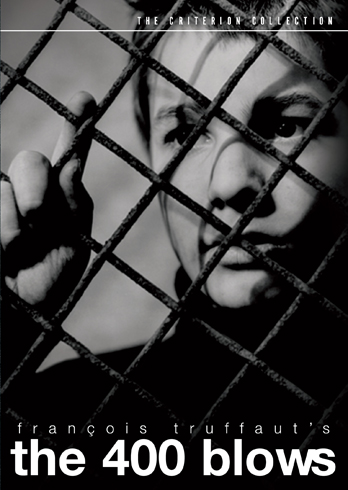
#5: The 400 Blows

(Francois Truffaut, 1959)

Like Catcher in the Rye, The 400 Blows doesn't do that much for me. I'm not sure why, though, because it really is an excellent movie, full of truth and imbued with a modern sensibility and style of filmmaking that would be copied in the next generation countless times. I had watched it years ago, and it failed to resonate with me, despite the fact that to this day I think Jules and Jim, Truffaut's third feature, is one of the best movies ever made. Over the past few months I had convinced myself that a fresh viewing would change my opinion.

This second viewing definitely improved my view of the movie, but I wouldn't go so far as to say this is a five-star classic. Still, some elements were much stronger this time around: the interweaving of the cinema into the movie, the impeccably edited amusement park scene, a performance by the lead actor that could be easily overlooked because it is so natural.

One thing I thought about when I was done with the film was the question of whether or not you have to feel some auto-biographical connection to a movie in order to appreciate it. Certainly, most people choose films based on their ability to recognize their culture and upbringing in the film. In my work, I often come across people who are white or black complaining that a movie is not for them because there are no people of their own race in the film. Because white films are the "generic" choice in America, white people often believe the conscious decision to make a movie about black people means that the film is not directed at them. Part of this is subtle societal racism, but most of it is the natural inclination of people (and in particular Americans) to be afraid of leaving their comfort zone. Just like a foreign film, a movie about black Americans, they believe, will include cultural references that they will not understand, and therefore cannot connect with, which will leave them either alienated or bored.

While childhood is a slightly but distinctly different matter, I couldn't help but feel that I didn't love the film because I didn't sympathize with the main character. His concerns have never been mine, his problems were not the ones I struggled with as a child. Moreover, unlike a film like Ratcatcher, which seems similarly foreign to me, I had no impression that The 400 Blows was taking me into a different world. In this way, the realism of the film might be held against it, even as I would unquestionably praise the depiction of childhood in the film for its lack of nostalgia and idealism.

I could probably name many movies that I felt less of an auto-biographical connection to than The 400 Blows. But because the movie seems so real and so personal, it is even more difficult to put myself in the shoes of Antoine Doinel. So even as the last image persists in my memory, and many of the film's characters seem vivid hours after viewing the film, I still feel distant from the movie in a way that my favorite films do not make me feel.

Sunday, January 24, 2010

#2: Seven Samurai

(Akira Kurosawa, 1954)

Seven Samurai is another Kurosawa classic, and most likely his most famous movie. I had seen it years ago, but had only remembered two things about it: it was long, and the last shot was of samurai graves, with dust blowing in the wind (late spoiler alert!). In fact, I had remembered it being in letterbox, but it turns out to be in good old 1.33:1. It's just the movie that is expansive, not the ratio.

I prefer a few other Kurosawa movies, but it is hard to argue with just how effective this film is, and how epic the story is. The entire second half consists of the battle to save the village, and it's all spectacular. Mifune, too, is excellent in the film, giving one of his best - and most atypical - performances as the peasant-turned-samurai triangle on the flag.

I'd love to see this one on the big screen, I can't even imagine what it would have been like to see it upon first release.

Friday, January 22, 2010

#4: Amarcord


(Federico Fellini, 1974)

Only after a viewing of this film do I finally realize that Fellini's movies are never really about anything. It's hard to describe what La Strada, La Dolce Vida, or even 8 1/2 is about without resorting to descriptions of the characters. So fine, Fellini makes movies about people, not events or conflicts. There are no conflicts in Amarcord at all, unless you count the desire to get laid, or find love, or live life well a conflict. Perhaps underneath this film there is that undercurrent of Fascism slowly creeping through Italian tradition, set to destroy the continent. But like Italy now, the movie mostly pushes that under the rug, treating it as something foisted upon the small town of the film that represents all of small town Italy, rather than something natural to it. (It's interesting, then, that the original essay for Criterion defined the film almost exclusively in terms of how it related to the fascism of the time.)

Perhaps Amarcord is a tad too sentimental, and I could see the case being made that the anecdotal structure is not strong enough to sustain the film, even allowing for its fundamental nostalgic - and therefore easily forgiven - tendencies. But I did enjoy the film, and I did find it charming and funny. Would I rather watch the three films mentioned above? Certainly. But it's interesting to view this back to back with Army of Shadows, as here are two immensely different films that are perhaps the most personal works of a master's career. They are two films that define what each director's films are truly about at their cores. The fact that I happen to prefer Melville to Fellini is perhaps one reason why I find Melville's film revelatory, while Amarcord seems merely slight and charming, like the town it depicts.

One more thing about this movie: I've lived in Philadelphia, Los Angeles, New York, and Boston, so I don't really know what the experience of living in a small town is like. I live a mostly anonymous life, so the scene that struck me most in this film was the evening scene where everyone is out and about and you can tell that everyone knows who everyone else is. It's the kind of experience that is impossible to replicate in a big city. I would be interested to know from someone who has lived in a small city in the US how much this film reminds them of their own experience, or if the movie is stuck to its time and/or place.

Saturday, January 9, 2010

#22: Summertime


(David Lean, 1955)

While it isn't quite the soaring romance of Lean's Brief Encounter, the love affair Katherine Hepburn spends her Venice vacation experiencing in Summertime is a respectable and beautifully shot rendition of the age-old story of the stodgy American and the sexually comfortable European (French? No, this time Italian).

Apart from the obvious appeal of seeing Venice in the 1950s from the POV of a wide-eyed newcomer, Summertime also boasts a great performance from Hepburn, the above-mentioned cinematography, and a plot that genuine got to me by the final climactic scene of Hepburn pulling out of the station, her lover running after her.

It does seem strange that this was so early in the collection, considering that while the film is a solid well-made one, it's certainly not on par with many of the heights in Lean's career, even others on Criterion. But sometimes it all comes down to what they get the rights to earlier, which was probably the case with this one.

I also just read that this was David Lean's favorite of the films he made. Which is, needless to say, fucking insane.

Wednesday, January 6, 2010

#3: The Lady Vanishes

(Alfred Hitchcock, 1938)

After reappraisal, this is my favorite British Hitchcock film. While The 39 Steps has a great clip to it, the combination of laughs, excitement, and real political intrigue at play here is undeniable. I believe I had always had trouble with the opening sequence at the inn during previous viewings. It felt too long, drawing out the movie's moments before the lady vanishes, as they say. But this time, those character steps made so much more sense to me (and class once again defines a British movie).

A large number of people far more knowledgeable about film (including Truffaut and Hitchcock scholar Robin Wood, who said it is the reason he became a film critic) have said it's so perfect that it is difficult to write about or analyze. I'll have to defer to them and leave it at this: If Hitchcock had never come to Hollywood and stopped making movies after the beginning of World War II, he would not be as famous (and my favorite movie ever, Vertigo, would have never been made). But he might be held in even higher esteem within film circles on the strength of The Man Who Knew Too Much, 39 Steps, and most importantly, The Lady Vanishes.

Tuesday, December 29, 2009

#24: High and Low

(Akira Kurosawa, 1963)

Zodiac was my favorite movie of the 2000s and I now have little doubt that David Fincher has seen and loved High and Low, the first fully contemporary Kurosawa film I've seen. This brilliant police procedural begins with a businessman maneuvering to take over his shoe company, but quickly transitions into a kidnapping plot, told from beginning to end in painstaking detail.

It's not just the detail and procedural nature of the film that reminds me of Zodiac. Both films are intensely complex technical displays from master filmmakers, mostly for narrative suspense, but occasionally for flashier devices such as the Transamerican pyramid in Zodiac and the pink smoke here. Both films feature intense, understated performances from their leads (though admittedly Jake Gyllenhaal is no Toshiro Mifune). And both films successfully merge the suspense and intensity of the crime with the monotony and work ethic necessary to solve it.

Of course, High and Low is not based on a true story, and the killer doesn't get away, so we get a satisfying conclusion (of sorts). Where Zodiac used the obsession and wide-ranging investigation of the case to create an epic, High and Low's far-reaching ambition is in the varied elements that pull together into a solvable case. The police use taped phone conversations, scraped paint, false newspaper stories, a child's drawing, plain old boots on the ground, and finally smoke twisting and turning up into the sky. The movie's focus is so tightly constructed that the narrative lacks any excess, which makes it even more impressive how big this movie's scope seems.

Finally, Kurosawa's direction - most notably his framing and spacial work here - is what makes this film so brilliant. For anyone watching this for the first time, pay attention to the blocking in the first sequences in Mifune's house, and how Kurosawa uses the camera to cycle between the characters, eliciting the perfect emotion at every moment. This is a master at work, even better out of his traditional element, but still at the top of his game.

Monday, December 28, 2009

#11: The Seventh Seal

(Ingmar Bergman, 1957)

The Seventh Seal is the first movie during this project that I have re-watched, which is to say that years ago (possibly as long as a decade and a half) I watched this movie, and haven't seen it since. I remember nothing from that viewing except that the chess game wasn't as awesome (or as integral to the plot) as it had sounded, and the film had seemed longer than it actually was.

Watching this time, I was still not blown away by the film in the same way other Bergman films moved me, most notably Wild Strawberries and Scenes from a Marriage. But I was struck by how, well, typical the film was. Unlike other Bergman films, The Seventh Seal reminded me of Hollywood movies, much in the same way Kurosawa was able to intellectualize and "legitimize" action-adventure films in the 1950s. The film's characters speak like most characters in film in the 1950s, and there are the same emotions and explorations of interaction present here. And the movie is funny. There's comedy all around, most notably in the two most important characters, the knight's sidekick and the actor who leads his family to safety, and in Death himself.

Sure, there is that eternal Bergman theme of the silence of God, but it is so naturally tied to the film's themes and plot that it doesn't seem a stretch to believe that the same movie made in America would have raised similar points. So The Seventh Seal feels more like, say, Starship Troopers than, say, Cries and Whispers. OK, there are no giant bugs, but there is a clear sense of entertainment, of the respect and love for Hollywood. It's funny how so many of the auteurs of the first popular wave of foreign cinema in America - Kurosawa, Bergman, Godard - owe so much to early Hollywood, yet fifty years later are seen as the antithesis of that system. Watching The Seventh Seal this time around made this paradox that much more clear, and while it helped the case for the film's timeless appeal, it didn't make me love the movie any more.

Sunday, December 13, 2009

#1: Grand Illusion

(Jean Renoir, 1937)

There are only a few movies in history that would seem right sporting the #1 spine. Jean Renoir's Grand Illusion is one of them, an undisputed classic from one of the most praised directors of all time. The film's main premise - that the notion of unresolvable differences between countries pales in comparison to the chasm that separates the classes the world over - is classic 20th century political film fodder. Renoir executes it perfectly, crafting a story about men stuck in the wrong war, the one about borders rather than social structures.

World War I is the classic anti-war-movie war, both because of its pointlessness and the sense that it was the last war of its kind, one fought with a different kind of honor. I might prefer the anti-authoritarian bent of Kubrick's Paths of Glory to the socialist manifesto on display here, and Renoir's own farce Rules of the Game might seem to me the more exhilarating send-up of the upper class. But Grand Illusion remains one of the great anti-war films ever made, and a great standard-bearer to begin the DVD version of the series.