Showing posts with label Noir. Show all posts

Wednesday, July 27, 2016

#810: In a Lonely Place

(Nicholas Ray, 1950)

Something a little different this time - I guested on a Criterion Close-Up episode discussing the first Bogart entry in the Collection.

Criterion Close-Up Episode 45 - In a Lonely Place

Friday, March 18, 2016

#793: The American Friend

(Wim Wenders, 1977)

Patricia Highsmith looms large in cinema when it comes to 20th century novelists. Her greatest contribution to the medium was Hitchcock's 1951 masterpiece Strangers on a Train, but Purple Noon (which is in the Collection) and Talented Mr Ripley are also significant works, both based on the same novel with different takes. Just last year, Todd Haynes delivered Carol, which was just hastily voted the best LGBT movie of all time in a BFI poll (the film's portrayal of lesbians stands in contrast to Strangers on a Train's homoerotic portrayal of the evil Bruno, a Freudian and outdated psychosis that mars an otherwise near-perfect film).

The American Friend is a loose adaptation of one of Highsmith's other Ripley books, one that hadn't even been published by the time Wenders bought the rights and decided to adapt it for the big screen. Unsurprisingly, Wenders did not stick to the novel closely, and The American Friend is consequently closer in style to Wenders's other films than to Highsmith's other adaptations. That said, there remains a bit of homoerotic subtext and many of the tragic undertones of ordinary people caught up in a story that propels them toward ruin that are present in most of Highsmith's work. The movie is a much richer noir tribute because of it.

Wenders makes movies that seem to exist in their own realities, a trend that culminated in his greatest film, Wings of Desire, which straddled the border between waking state and dreamworld, this life and the one after, cinema and transcendence. The American Friend is no different, though it desperately wants to belong to the long tradition of American noir and lost 60s idealism of Hopper's own films. Although Hopper was not Wenders's first choice for Ripley, he matches the tone of the film perfectly, and I don't think it would be as meaningful with a pure actor in the role. There's very little in the way of suspense here, though the two murder sequences are tautly constructed, and Wenders is instead more interested in the layering of emotional connections and the quiet descent into noir-styled fatalism. Many noir films unfurl like dreams, which has often led to surreal entries in the genre. Wenders opts for gritty and deliberate realism, which elevates the drama to mythical levels anyway.

The American Friend is most notable as a Wenders film, but it's still an excellent thriller with existential charm. It's a minor entry in his catalog that sets the stage for the recently announced Road Trilogy and likely more Wenders in the coming years. (The State of Things? Until the End of the World? There have been rumors of Buena Vista Social Club.) Hopefully that set will match the towering charms of Wings and Paris, Texas, but for now this will do as a holdover.

Tuesday, February 9, 2016

#750: Ride the Pink Horse

(Robert Montgomery, 1947)

Ride the Pink Horse is the kind of movie that falls through the cracks in Criterion's release slate, but represents one of the best things the company has to offer. This is not an iconic work of world cinema, nor is it even a five-star or cult classic. But it is a decidedly quirky picture that carves out a relevant niche in noir history.

That it is noir is of relevance to Criterion, as they have dug particularly deep on this genre with pictures like Blast of Silence and a surprisingly wide range of Dassin's American films. Noir is obviously one of the definitive genres of the medium, and its intertwined history with the New Wave filmmakers like Godard who pushed for the recognition of the genre and incorporated its signifiers into their works makes it Criterion friendly. These were also often B movies, making their value in home video less apparent and therefore available to Criterion - which is also why unlike other major genres Criterion has almost none of the core definitive classics of the genre like Double Indemnity, The Maltese Falcon, or Out of the Past (though they do have Kiss Me Deadly and recently added the sort-of-noir Gilda, plus a wide range of foreign films that were either influences on the genre or inspired by it).

Ride the Pink Horse is similar to the other American noirs in the Collection in that it didn't have an especially high profile before its Criterion release, and really doesn't have much of one now, either. As a director, Robert Montgomery is probably best remembered for his debut, the Chandler-based noir The Lady of the Lake, one of the few movies to sustain a first-person POV for the entire film (Montgomery plays the famous Philip Marlowe in the movie, whom we see only through mirrors). It's a novelty that grows tiresome quickly, and I only made it through the film out of pure devotion to the idea of experiencing Chandler's work with such an unusual concept (one that Chandler himself didn't care for, unsurprisingly). Ride the Pink Horse, on the other hand, held my attention throughout, and while I don't think it's an unheralded masterpiece or anything, I have a hard time imagining any fan of noir having any serious problem with the movie.

One of my favorite things about the film is the opening. The credits roll over a desert scene matched with music that would be at home in any Western of the era. When combined with the horse in the title, it is a confusing opening for anyone convinced of the film's noir bonafides. Yet as the credits end a Greyhound bus comes roaring in and the camera pans into a town in the contemporary West. It starts the film off by subverting your expectations, a trick that comes in handy as the plot unfurls and people are not always what they seem.

Montgomery is not the best director in the world, but he was a solid leading man and he had a ton of top shelf help here, from the great Russell Metty behind the camera (who would go on to shoot the similar but significantly superior border noir Touch of Evil for Orson Welles) to a screenplay by Ben Hecht and Charles Lederer, two of the greatest writers in film history. The dialog is spectacular - really, I could watch this movie ten times just to take it all in and savor the great lines.

Perhaps the most interesting thing about Ride the Pink Horse, though, is its depiction of Mexicans. Montgomery has an unfulfilled love affair with a younger woman who attempts to bridge the social divide (played in brownface with a Speedy Gonzalez accent by a white lady), but the stand out character is Pancho (the actor was, according to Criterion, the first Latino ever nominated for an Academy Award for this performance). Pancho carries plenty of the stereotypes of Mexicans, living the poor-but-happy life of an alcoholic who falls asleep under his sombrero. But he's also a stand-up guy with loyalty that survives intense and violent testing. Mexican characters don't often fare well in early border pictures (think even Charlton Heston playing a Mexican in Touch of Evil, one of the more regrettable elements of that classic), so even though Pancho often lacks the full three dimensions of humanity it's nice to see a lovable and honorable character like this in a film from the 1940s.

Ride the Pink Horse is unlikely to become anyone's favorite noir, but many of its defects are the very reasons why it would be easy to fall in love with it. The various stylistic choices (the wordless opening, the merry-go-round rough-up, etc) seem disjointed, in need of a steady hand to connect them that isn't really there. Similarly, the quirky bits of character and asides that are unrelated to the core plot hurt the momentum of the suspense, but are the exact moments that separate the movie from its noir cousins. There's a lot of talk about what the best or worst releases from Criterion are, but Ride the Pink Horse is unlikely to come up in either conversation. Instead, this little-seen previously unavailable blu-ray says a lot about Criterion's continued devotion not only to the classics or contemporary film, but to the history less traveled in order to give a better, fuller picture of what cinema is all about.

Wednesday, September 24, 2014

#710: Judex

(Georges Franju, 1963)

Judex is basically a French version of The Shadow, an early prototype of the superhero genre that would define comic books for the modern era and is currently holding the summer box office in a choke hold. This remake of the original film adaptation of the character is a movie in love with movies, the illusion and freedom that define the artform.

I had never heard of Judex (or even the character) before the title was announced, though it wasn't a totally left-field choice considering Franju had directed Eyes Without a Face, an early addition to the Collection. I enjoy that movie a lot, and what little I read about it before watching had me thinking this was going to be one I really loved. It sounded like a stylish and playful mind game that didn't bother to follow the rules of logic or realism.

Ultimately, though, I just sort of really liked it. The core story of the film is interesting but doesn't lead to much, as a lot of the explanation of backstory that was supposedly included in the original film has been nixed. This makes the movie a bit more like a fever dream, which is cool enough but doesn't allow the experience to add up to much. There's also a woman at the center of the film who is pretty much everything you could ask for in a stereotype of woman as a ruthless bitch, which is either a coincidence or a symptom of the time. But the movie is so pulpy and silly that it's hard to criticize it for anything other than not being pulpy and silly enough to elevate it to something really special.

Monday, February 11, 2013

#475: The Friends of Eddie Coyle

(Peter Yates, 1973)

The Friends of Eddie Coyle is one of the great finds in Criterion's catalog. I first saw it when Criterion released it four or five years ago (it had never been available at home before) and was totally blown away that this film had slipped through the cracks. Along with being a great Boston movie, it also features one of Robert Mitchum's best performances and some great supporting actors to surround him. But the real elements that make this such a lost gem are Yates's direction and the intricately constructed and nuanced script. This type of unsparing crime drama set the stage for the best of the genre to come, including the greatest television show of all time, The Wire.

The film is combination of dense and perfectly toned conversations and intense, nail-biting suspense sequences. The script doesn't bother with exposition and bets instead on the viewer's willingness to keep up as best they can. The first time I watched the film I was somewhat lost for the first half hour or so, but quickly caught on to what I needed to know. Coming back to it, the plot is much simpler and it's easier to sit back and enjoy the dialog, particularly between Mitchum and his gun-runner both in the early coffee shop scene and the chilling bowling alley scene in which Mitchum threatens him more overtly. This script should be taught in schools - the dialog is that well-constructed. Interestingly, there have been comments to the effect that there were a healthy amount of scenes left out - though it would be interesting to see these moments, I have a hard time imagining what would be needed.

These editing decisions seem to me to be just another indication of how in control Yates is here. The director made the excellent Bullitt a decade before and would go on to make Breaking Away and a handful of other well-received movies, but he never really gained much recognition and his death a few years ago did not usher in the reappraisal his work deserves. This movie's bank robbery sequences are quite simply terrifying and as taut as can be. Yates avoids most of the dated techniques of the era and presents the sequences simply and with a cold eye, making for total uncertainty and realism. The movie is most successful as a human drama, which is of course its main intention, but the way Yates uses these moments to highlight the calculation and nature of these characters and the terror they force onto innocent people both underscores this drama and makes for riveting suspense.

The Friends of Eddie Coyle has a huge following, as illustrated by the passionate comments on Criterion's essay page. Part of this following comes from a regional pride that I know all too well living in Massachusetts, but much more of it come from the film's combination of suspenseful direction and dense plotting that rewards multiple viewings and the effort it takes to unravel the various dynamics. It's also a remarkable look at mid-level crooks and their very real struggles to reconcile their careers with their identities. Mitchum's tragic Coyle is a man playing at one thing or another, but whether it's gangster, loyal father and husband, honorable crook, or scheming snitch he's not sure. It is always clear that the film's sympathy for him will not save him from his inevitable fate, and even if it is surprising how it came to be, the cards were dealt long before the film began.

Friday, December 21, 2012

#481: Made in U.S.A.

(Jean-Luc Godard, 1966)

Some thoughts on Godard upon my viewing of Made in U.S.A., the last of his films in the Collection that I had yet to see:

-- Has anyone ever cared about the story in a Godard film? I mean, sure, you can get wrapped up in the human dynamics of Contempt or the love story in Breathless. But the movies seem so far separated from reality that I have a hard time believing anyone could take enough time inside of the world of the film to forget you are watching a movie and get wrapped up in what is happening. I don't know that I've ever really cared much for his characters, either. This might make his movies hollow - and they certainly would be in the hands of any other director. But Godard has a way of turning this weakness into a strength, and even a genre film like Made in U.S.A. feels constantly fresh rather than confusing and dull.

--Is it impossible to appreciate Godard's films outside of their cultural context? This is especially aimed at his work from the 60s and 70s, particularly his work where things like Vietnam and the student protests in France began to seep into his work. But Godard's early career wasn't just about politics, and his modernist twists on film were as much comments, perhaps love letters, to earlier work. WIthout knowing that work - which would have been much harder for people seeing the films in their initial release - the movies would certainly seem even more strange than they already are. Does this make Godard and weaker or a stronger director? The answer seems to depend on how deeply you value standalone work and how open you are to criticism and cultural reappropriation in your movies. There is no definite answer as to its value, but I do think appreciating his films without any context would not only be difficult, but missing the point.

-- At one point in Made in U.S.A., Godard's semi-ode to the jumbled American noir he loved so much, his muse Anna Karina tells someone, "You can fool the movie audience, but you can't fool me." How tired this line would be today, yet how invigorating it is to see it in 1966! Jokes like this are everywhere in Godard's work throughout the 60s, and it's hard to tell how seriously he took a joke like this (and by extension how seriously he took his films). Much of this comes down to intention, something difficult to pin down with the elusive Godard. I don't think anyone would argue that Godard wasn't an ambitious filmmaker, but his tour through genres and consistent self-commentary makes him look a lot more like an intellectual explorer than a self-serious filmmaker. A referential line like that serves as a cultural in-joke, which takes you out of the movie somewhat, just as its structure and sentiment echo countless lines from the genre pics with which the film claims to belong.

-- Sometimes it can be funny how highly regarded Godard is when his films are so impish and slight in tone. Compared to similarly towering figures like Tarkovsky or Kurosawa, the director seems like a teenager lashing out at mom and dad - albeit an extremely talented teenager. Of course, it could certainly be argued that despite his sly side Godard was more sophisticated and complex than either one of those two filmmakers. In fact, the way he chooses to present his movies often seems designed to challenge the way we watch movies - he's more Brakhage than Hawks, even when going brightly noir. It's what makes his movies so significant, both technically and philosophically.

-- I read a great piece recently about the Godard paradox - the idea that his movies are inherently of their time, infused with references to the past, but constantly looking towards the future. But interestingly enough, what it immediately reminded me of was commercials. It's a format that is constantly addressing the future (i.e. when you finally get the product), which roots it in the present. This comparison becomes even more relevant when considering Godard's use of typography and graphics. I'm not sure where this leads - it's just a thought I had about his work.

-- Having seen 15 or 20 of Godard's films at this point, it's hard to think of another filmmaker that has generated such different reactions depending on the film (I'm excepting hacks like Rob Reiner and Barry Sonnenfeld, who have stumbled into classics but mostly make garbage). Rather than lower my opinion of the director, it makes me like him even more. I doubt Godard, ever the provocateur, would have it any other way.


Friday, September 14, 2012

#322: The Complete Mr. Arkadin

(Orson Welles, 1955)

Excepting people like Jean Vigo and James Dean who died young, there is perhaps no career in film history more tragic than that of Orson Welles. Director of the greatest second greatest film ever made, Welles followed up his debut with another masterpiece in The Magnificent Ambersons. Yet this film was massacred by the studio, who eliminated nearly half of the running time and butchered what was left, leaving a husk of Welles's intended work. Tragically, this was a harbinger of how his career would continue, and the rest of his oeuvre is filled with  severely altered works, half-made epics, and a long trail of never-made screenplays and treatments.

Although The Magnificent Ambersons and Touch of Evil often get more attention for their checkered post-production history, Mr. Arkadin is certainly the greatest mystery in Welles's career. Made in 1955, the film went through multiple iterations in its initial release across Europe and the US. The famously contrarian Cahiers writers declared it better than Citizen Kane upon its release, despite the fact that the cut they saw was not finished or approved by Welles. Viewing that version now, along with the Criterion version that attempts to most closely approximate Welles's original intentions, it seems almost laughable that anyone would compare this film to even Welles's secondary classics like the two mentioned at the beginning of this paragraph, let alone to his greatest masterpiece.

The biggest problem with Mr. Arkadin is Robert Arden, the lead. He's simply terrible, stammering and hamming his way through what might have been a moderately enjoyable role had it been tackled by anyone competent. The addition of his narration in Confidential Report makes it even worse, since it becomes even more his picture (though the awkward cuts in this version are its real downfall). Welles is equally hammy in his fake beard and on-again off-again accent, but he was always able to carry off even the cheesiest performance with a knowing wink and childlike enthusiasm.

The story of the film has some real appeal, and it's easy to see why Welles would have been interested in making it - there's a sort of Citizen Kane-through-the-looking-glass thing going on that I dig. Still, this probably wouldn't warrant a release if it wasn't for the various elements and different cuts that make this a worthwhile boxset. Then again, if it wasn't for all these disparate versions, we might have a singular, far better film - something said all too frequently about Welles's output.

By the way, I wonder why Criterion would upload the inferior Confidential Report to their Hulu page, rather than their own "definitive" edit, which they must certainly have the rights to. It's rather annoying, I think.

Friday, December 16, 2011

#413: Drunken Angel

(Akira Kurosawa, 1948)

Drunken Angel is the second early Kurosawa film I've watched in recent days, the first being Stray Dog. The two movies share a lot more than their director and leading man, Kurosawa and his favorite leading man Toshiro Mifune. Their post-war Tokyo settings make the perfect backdrop for noir that is distinctly Japanese, and each film is about the lead characters struggling to reconcile their position in life with the person they want to be.

Structurally, the biggest similarity is the fight that becomes the final confrontation in each film. They are both shot impeccably and deliberately, but the fights themselves are clumsy and realistic. Mifune's movements seem desperate and authentic, something we so rarely get to see any more now that fights must be slick and impressively choreographed (ironically, this trend comes from Eastern films).

But despite these similarities, I enjoyed Stray Dog much more. Part of this is the noir-styled mystery at the heart of that later film - it's more exciting and engaging than the melodramatic relationship between the two leads here that is the core of the film. But I also really loved seeing Kurosawa execute a film in such an experimental fashion in Stray Dog. That movie just seems so much more illuminating with regards to Kurosawa's developing voice whereas Drunken Angel feels more like a talented director making a movie before he had an identity. I enjoyed Drunken Angel, but it's Stray Dog that in my opinion kicked off Kurosawa's renaissance.

Saturday, December 10, 2011

#233: Stray Dog

(Akira Kurosawa, 1949)

Kurosawa's easy counterpart in the West is John Ford. Just as Ford made the Western internationally iconic, Kurosawa popularized the samurai film outside of Japan - and just as Ford would eventually demythologize the genre he was most known for later in his career, so too did Kurosawa. Likewise, both directors made classics outside their respective comfort zones.

But the comparison I come back to over and over with Kurosawa is Hitchcock. There are the critical parallels - both directors made more classics over a longer period of time than perhaps any other filmmaker in history. And certainly the two filmmakers made some of the most unapologetically entertaining films of their era. Kurosawa was definitely the more socially minded of the two - Hitchcock was nearly always more concerned with the inner-workings of the human psyche (Kurosawa's 20th century-style tendency towards socialism mirrored Hitchcock's own timely fascination with Freud and psychoanalysis) - but their work was filled with troubled fractured heroes tasked with redeeming themselves in their own minds.

Stray Dog makes the comparison more apt by presenting Kurosawa's Japanese take on a Western genre. But the film takes its cues not from the suspense thriller genre, but from film noir. Replace the fan in each character's hand in the early scenes here with a cigarette, and you could be looking at any number of potboilers from the same post-War era in Los Angeles. The social conventions at work in the interactions between the cops and lowlifes in the film make for fascinating comparisons with their Western counterparts, the stuff of graduate theses. Gradually however, the film sheds its purely noirish structure and becomes more of a social picture exploring post-War Japan and the nature of good and evil. As is alluded to in the essay accompanying the DVD, Kurosawa flips the traditional noir theme of the individual being consumed by society and instead argues that we are all connected, even one. The final showdown in the film is both intense and moving - there is a desperation to both men which reduces them to animals in the final, clumsy encounter.

Speaking of connections, there are two modern films that owe a great debt to Stray Dog. One is Magnolia, where Paul Thomas Anderson obviously used the core premise here of a cop losing his gun for John C. Reilly's subplot. The other is Body Heat, one of the few modern noir masterpieces. The two films share their once-removed noir status (Stray Dog's is geographical, while Body Heat's is temporal), but where they clearly overlap is sweat. Both films take place during a suffocating heatwave, and I'm not sure I've seen many other films that convey the sluggishness of the experience so consistently (one Criterion film that does so in a different way - by use of color and light - is Do the Right Thing, thanks to brilliant cinematography from the masterful Ernest Dickerson). Here, as in Body Heat, the temperature puts a weight on each character's shoulders - everyone in the film has something else on their minds other than the task at hand except Mifune himself.

There is another Criterion connection here. The sequence in which Mifune goes undercover to find a gun dealer is remarkably similar to the scene in which Joel McCrea goes undercover as a hobo in Sullivan's Travels in order to learn what it is like to live poor and despondent. Both scenes last an unusually long amount of time with little to no dialog. They convey the emotions of the characters through their experiences, but also through the experience of the viewer - each would be far less effective at half the running time.

Overall, Stray Dog was a bit of a surprise for me, an early masterpiece from Kurosawa which flirts with many of the themes of his later work (particularly The Lower Depths and High and Low) but sees the director flirting with many more openly complex techniques and displaying his influences more overtly, which may be why he later dismissed it as an early failed experiment. He's extremely wrong, of course, as Stray Dog turns out to be another classic from a man who - particularly in a fifteen-year-period around the 50s - seemed to have an endless supply of them.

Friday, September 2, 2011

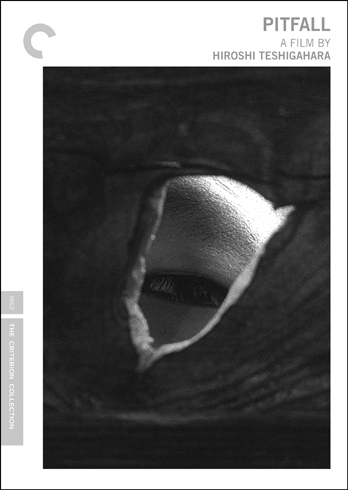
#393: Pitfall

(Hiroshi Teshigahara, 1962)

Pitfall is an investigation into the unseen forces in life. This means ghosts, for sure, but the film is not a ghost story. It's not about higher powers, either, but about the powerful and the powerless. It's a dark picture about a man in a white suit that doesn't bother to offer answers. Instead, it paints a picture of a world where we are all pawns in a larger game.

The only film of Teshigahara's I had seen before Pitfall was Antonio Gaudí, the mostly silent documentary about the famous Spanish architect. That made me ill-prepared for his fiction work, and the first few moments of Pitfall are akin to being forced to walk with a different rhythm. This comparison could be applied to many filmmakers in the collection - most notably Ozu, Bresson, and Renais - but it feels especially apt here because Teshigahara's work is so simultaneously allegorical and ultra-realist. Pitfall is a film about a miner attempting to make a better life for himself and his son. Through this premise the film explores the economic difficulties of the work, how mines are tied to the larger society, and the place of unions and their management in that society. But it's not really about any of this, because the film could be set anywhere and effectively convey the same themes of alienation, despair, and powerlessness.

That all sounds very depressing, but the way Teshigahara constructs the film is invigorating. His camera alternates between dirty close-ups and sweeping vistas, and his tone is surprisingly warm. This might be the only ghost story I've seen that lacks any sense of haunting mysticism. Because of this, the fact that the movie ends without a typically satisfying conclusion was not dissatisfying, but purely logical. Pitfall is certainly a challenging film, but it's most impressive because Teshigahara is able to balance the opaqueness with a sense of unity. The man in the white suit might be coming for you, but at least he's coming for all of us.

Saturday, July 23, 2011

#427: Death of a Cyclist

(Juan Antonio Bardem, 1955)

Death of a Cyclist is statement film, a subtly ambitious genre pic, and a terribly entertaining message movie. It's also the earliest Spanish film (in terms of theatrical release) in the collection. This seems fully appropriate - like another ambitious genre pic, Citizen Kane, it's entirely believable that an industry could have sprung from the roots it planted, such is the impact the film seems to have even now on a stagnant cinematic landscape.

The film starts with the titular event, caused by a car driven by the two main charaters, Juan and Maria. Fearing their illicit affair would come to light if they stopped to call the police, they leave the man to die on the road. That cover shot, bicycle wheel spinning at the bottom of the frame, is the closest we get to the victim. This movie isn't about the event, but rather its aftermath, which throws everything in these characters' lives, both personally and professionally into disarray. As their fates become clear, the movie slowly builds to its inevitable climax - like Hitchcock, who obviously influenced the film, Bardem generates suspense despite the fact that there is never a doubt as to where the film is headed. The flashiest section of the film is probably the first act, where time shifts all over the place while scenes are connected by seemingly separate actions (one character blows smoke, another character in a different place and time watches smoke float across their face). But the movie is consistently fresh throughout its running time, and the final result works on many levels, from classic noir to social critique.

The characters in Death of a Cyclist are richly nuanced and defiantly conflicted. This makes the wide ambition of the movie work, because Bardem was able to say everything he wanted to say while still providing an entertaining premise. The director is the uncle of Javier Bardem - probably the most famous Spanish actor after Antonio Banderas - so his family has a substantial presence in Spanish cinema. But it's this film that remains a stand out in his career - along with The Devil's Backbone (which was directed by a Mexican), this might be the best Spanish film I've ever seen.

Monday, July 4, 2011

#172: Pépé le moko

(Julien Duvivier, 1937)

Pépé le moko is a reminder that the French weren't simply inspired by film noir, but instead had a hand in creating that most American of genres. Just as many of the established stateside classics were directed by studio journeymen from pulp novels, this pre-WWII masterpiece was brought to the screen by the still largely dismissed Julien Duvivier and based on a book written under a pseudonym by a French policeman who had spent time in Algiers. The film nails its setting, allowing the camera to jaggedly cut its way into the narrow corridors of the winding streets that make up the Casbah - often, it feels like the district is actively resisting the film, trying to expel it from the corridors. Meanwhile, Jean Gabin lords over the proceedings in a dominant performance.

Gabin is - if I am allowed to generalize and simplify for a moment - the French Bogart. Though neither actor is traditionally attractive, the camera gravitates towards them effortlessly, almost magically. Both actors required little background or establishing character traits to legitimize their towering presence within a film's universe - they simply were, in the grandest sense of the word. Nowhere is this comparison more apparent than in Pépé le moko, which shares a number of superficial elements with Casablanca, the film which immortalized Bogart. Both movies are set in French Africa populated with double-crossing thieves and deep shadows around every turn, and both center around a doomed romance. More importantly, though, each film has its respective star as both the gravitational pull of the story and the setting's folk hero. Gabin and Bogart must be iconic figures for the motivations of the surrounding characters to make sense, and each star pulls this off with effortless suave.

Besides Gabin, the most interesting element of Pépé le moko is the romance which is Gabin's undoing. Gabin falls in love because he is tired of running and longs for his home in Paris, but the playgirl he falls for seems drawn to him as a novelty. We must rely exclusively on Gabin's admittedly powerful presence to convince ourselves that she really is in love with him and isn't just in it for the thrill. If Gabin had gotten away, would their relationship actually have lasted even as long as the ship's journey back to Europe? This seems to me less a question about whether or not the love story is legitimate and more about whether or not this mystery playgirl represented an actual person (or even just a symbol of personal love) rather than France itself - or at least the France Gabin knew. He discards his "exotic" lover in the Casbah (who then betrays him) with ease, and she seems to sit in for Algiers in general. Gabin's choice is France over Africa, and his final moment is the confirmation of his love for his country - if France can't have him, no one can.

Patriotism might seem like a strange theme for a film that features a decidedly anti-heroic protagonist. But Pépé le moko has little interest in condemning Gabin, even though it is consistently clear that he won't escape a moralistic fate before "Fin" flashes on the screen. Even before noir (and even before pre-noir) cinema glamorized those who burned brightest, even for an instant. Interestingly, we never get to see Gabin's finest moments as a thief in the film, since we enter the story as he is already in hiding. His most cinematic moment, then, is his last, when the Casbah can no longer contain him and France calls him home. Regardless of its allegiances, Pépé le moko is a brilliant and moving work of pre-noir pulp, and one of the defining "movie star" performances of French cinema.

Tuesday, April 26, 2011

#564: Pale Flower

(Masahiro Shinoda, 1964)

Pale Flower is a love story where the two characters have no idea how to love. When the gangster Muraki first encounters the mysterious Saeko in an underground gambling den, he has just been released from prison for killing a man. He's immediately infatuated with her, but it's not entirely clear why beyond her obvious beauty and the novelty of her presence in a mostly male world. Like other damaged-love stories, Muraki and Saeko come together through mutual fascination - he is fascinated by her constant search for an adrenaline rush, while she is drawn in by his ability to take a life. But Pale Flower isn't like similar films because at no point during the film does it seem likely that their relationship will be consummated or even fully expressed. When Muraki runs into Saeko in her real life, he seems entirely disappointed with the fact that she exists. It is clear he wishes he had never seen her. Yet he is fascinated by her double life, and the scene takes on an erotic quality that makes the film around it seem all the more sexual.

Masahiro Shinoda made Pale Flower as a direct response to the popular yakuza films of the era, but really Shinoda is channeling Godard and Melville, with a splash of b-movie Hollywood noir. The director uses all manner of cinematic techniques, and while some of them come across as meaningless flash, other elements (particularly the dream sequence) are as mesmerizing as Toru Takemitsu's score, which blends in with the rhythms of the gambling sounds that populate the characters' world. The film's dull nihilism manages to avoid easy traps because of the technique on show.

Shinoda has two other films in the collection: Samurai Spy, which I had mixed feelings about, and Double Suicide, which I have yet to see. Both of those films were made after Pale Flower, and it's clear this is the work of a young director (he was in his early thirties at the time). The story is ambitious where more mature filmmakers would have been intimate, the style is flashy where subtlety would have seemed more impenetrable but also more intense, and the film's freewheeling attitude reminds me of Miike's Ichi the Killer (minus the torture and bisected bodies). I have little doubt that Quentin Taratino loves Pale Flower.

This might all give the sense that I thought Pale Flower was a less successful film. But these choices don't make the film worse, just different than it might have been in other hands - less delicate, perhaps, but more energetic. Furthermore, the anti-love story at the center has left me haunted, and despite the various flourishes I think Melville would approve of Shinoda's work here for this reason. Pale Flower is about these two characters - the warring gang plot is merely a vehicle to get Muraki to kill again, his dalliance with the other woman a counterpoint to his confused and unrealized feelings towards the focus of his affections. In this regard, the film is wholly successful and extremely moving. The final moments of the film could come off as supremely frustrating, but instead they are the key to the whole puzzle: these characters aren't interested in the people who catch their affection but in the thrill of the moment. Once the card is turned over, its spell is broken.

Sunday, April 24, 2011

#245: Port of Shadows

(Marcel Carné, 1938)

Perhaps because of the combination of title and cover, I expected Port of Shadows to be more of a noir prototype than it actually was. Instead, Port of Shadows is more La Bête Humaine than Touchez pas au grisbi - and not just because Jean Gabin made the two films in the same year (working with Carné and Renoir in one year is kind of a staggering achievement itself). Both films center around a man who is a bit of a loner, hurtling towards his personal fate through passion and principle. They are also both fairly melodramatic and aimed squarely at "the people," those huddled masses that - in the 30s especially - wanted to see their own lives on screen, however brighter they seemed to shine up there.

The film owes most of its success to Gabin, a true movie star here playing a soldier who appears to have gone AWOL just before he arrives in a bustling port town and promptly falls in love with the wrong girl. Promises are made, prides are bruised, and as always by the end a hero falls.

The film takes some time to get going, but once it does, it's easy to become invested in Gabin, even though we know very little about his background. The plot of the film and even the characters he encounters seem inconsequential - this is all about legend building, and like Bogart in The Big Sleep, Gabin seems above it all even when he's getting his hands dirty. Port of Shadows clearly went through hell in the years before Criterion's release, and a lot of the picture's grand photography is under the cover of 70 years of neglect, especially when compared to more well-known films of the time. But Carné's work still has moments that equal his star, and the film ends up being quite enjoyable for fans of pathos.

Sunday, April 3, 2011

#174: Band of Outsiders

(Jean-Luc Godard, 1964)

Once again, as he had done in his debut classic, Godard gives us a girl and a gun in Band of Outsiders. Coming off perhaps the angriest work of his early period with Contempt, Godard turned back to many of the cinematic references of Breathless and the meta winks toward the audience of A Woman is a Woman. The final product is a borderline masterpiece that ranks just a notch below his best work for me.

The first time I watched Band of Outsiders was about a decade ago, when I was first falling in love with many of the films Godard nods to in the film. It hit me especially hard for two contradictory reasons: Godard was internalizing and then recontextualizing the same elements of cinema which had moved me, and yet he was doing so in a manner that seemed distinctly out of step with my contemporary reality. The director's work is tied to the 60s not only because he defined and shaped cinema in that era (is there anyone who doubts that this film and Truffaut's Shoot the Piano Player had a significant impact on Bonnie and Clyde?), but because his ideas and aesthetic are constantly looking forward, pushing towards the outer reaches of cinema. There is nothing that dates a film like its perception of the future, and many of Godard's films lack the vibrancy they must have had for a contemporary audience. The fact that his films remain relevant is a testament to his skill, but unlike directors like Ozu and Kurosawa in the East and Bergman and Fellini in the West, Godard often shied away from universal timeless themes in order to tell his stories.

This isn't to say Godard's films are removed. There is loads of emotion in Band of Outsiders, especially romance and melancholy. But the moments I come away from the film with are of a decidedly technical - if totally playful - slant, like the moment of silence where the film follows along with the characters, or the race through the Louvre to beat the American-set record for fastest visit. These moments seem designed to remind you that you are watching a movie - a Godard movie at that! - and you shouldn't get too worked up about any little thing. Godard told stories that were just as relatable as the stories of the other directors mentioned above, but the way he told them was so distinctly of its time - both socially and artistically - that his work can't help but appeal more to the brain than to the heart.

Saturday, January 22, 2011

#434: Classe Tous Risques

(Claude Sautet, 1960)

Classe Tous Risques is a very good movie, but it's a lock for inclusion in the Collection because it stars two of the greatest French stars of all time, Lino Ventura and Jean-Paul Belmondo. Watching these two together (Belmonde had just made Breathless, and was not yet a star) is a real treat, and it turns a slightly plodding film with no real transcendent moments into an enjoyable exercise in noir.

Ventura plays a crime boss who fled France years before at risk of being arrested. When he attempts to return with his wife and children, he realizes the path isn't going to be as smooth as he had expected. Before long, his old friends have turned on him, and only a rogue thief played by Belmondo is willing to help him out.

Both actors give their trademark performances, with Ventura projecting a complex and quiet strength, while Belmondo effortlessly oozes cool. But the movie itself is only intermittently suspenseful, and while the performances make it compelling and engaging, Sautet (who was essentially debuting as a director) isn't the filmmaker Jules Dassin or Jean-Pierre Melville was. I also found the narration, while informative, to be awkward and abrupt, particularly at the end, which left me somewhat unsatisfied.

Classe Tous Risques ends up being a worthwhile viewing for anyone interested in the 50s and 60s French noirs. But it's definitely not a classic of the era, and remains more notable for its stellar pair of stars.

Friday, December 24, 2010

#107: Mona Lisa

(Neil Jordan, 1986)

Mona Lisa belongs to two crudely constructed genres which generally don't thrill me: the performance film and the slice of vaguely noirish cinema in which naive men become exposed to the dark sexual habits to which women often fall victim. The latter - to which a massively wide-ranging quality of films belong, including everything from Taxi Driver to the recent joke/surprise hit Taken - can often be either oppressively dark or weirdly fetishistic. Taken, for example, revels in the male fantasy of protecting untainted girls from the evil grasp of the rest of the horny male sex, all while pretending (albeit very vaguely) to condemn conventional concepts of sex and gender power dynamics. It's a "have your cake and eat it, too" style of filmmaking that, sadly, can be easily well received by the general moviegoing public (worst of all, Taken was especially popular among women). On the other hand, Taxi Driver, of course, leads to the destruction of civilization, to the point where even any kind of redemption that can be taken from Travis Bickle's final moments is difficult to carry under the weight. (Side note: I feel I've been comparing really amazing movies to really awful movies a lot recently.)

Mona Lisa, fortunately, avoids both of these conclusions, instead depicting an entirely realistic and extremely moving climax which avoids both exploitation and hopelessness. A big part of this success can be attributed to Neil Jordan, who manages to make the film moody without being mannered, and generally paints a melancholy but redemptive picture of London as a noir capitol. But most of the success can go to Bob Hoskins, who is simply stunning and heartbreaking as George, an ex-con who slowly falls in love with the prostitute he's charged with driving around town to her various johns. There aren't a whole lot of performances that spring to mind that can compare to Hoskins here, who is understated and controlled where his character from The Long Good Friday was oversized and full of fire.

It's easy to compare the two movies, really, since both are British noir films starring (really, entirely focused on) Hoskins. But Mona Lisa has none of the religious baggage the earlier film had (here, I guess, it's mostly sexual) and though it lacks the energy that carried The Long Good Friday through to its climax, it makes up for it in personal stories that carry far more weight and simply feel more relatable. Even if it takes some time to get going, it's a very strong picture, one of Jordan's best, and even though I usually shy away from movies that center around one major performance, Hoskins makes Mona Lisa a must see.

Tuesday, October 19, 2010

#80: The Element of Crime

(Lars Von Trier, 1984)

Sigh.

Well, I will say one thing about Criterion and their insistence on liking Von Trier: it's not an overnight phenomenon. As an early addition to their DVD run, The Element of Crime is a strange frustrating installment, a bizarre mix of uninteresting trashy noir and technically impressive (but ultimately hollow) cinematic style. The movie looks beautiful, and by beautiful I mean horrible, disgusting, unappealing, and unlikable. Perhaps this is what I meant Hunger should look like, which makes me doubt why I was complaining about that film's appearance anyway. Who wants to look at crap when they can look at beauty?

And, really, The Element of Crime is crap. It's partially crap on purpose, and it's also crap for a lot of reasons I have problems with Trier's work. The two that most bother me with his work are that it's incredibly sexist, and it has a disdain for conventional filmmaking that is only matched by its constant derivation of material from classic filmmakers. But really it's crap because Trier is an incredibly talented filmmaker who has occasionally stumbled into great work, seemingly unintentionally. I don't say that because he is clueless, but instead because I genuinely don't think Trier has any interest in entertaining an audience, or even really engaging with one. He just wants to be an asshole. Sometimes assholes make great art because what they say needs to be said. I personally think that's happened a few times with Trier, but I wouldn't be surprised if I was wrong.

Wednesday, August 18, 2010

#271: Touchez Pau Au Grisbi

(Jacques Becker, 1954)

I thought I was being insightful when I realized halfway through Touchez Pau Au Grisbi, Jacques Becker's extremely enjoyable and nearly classic noir, that the film echoed a similar near masterpiece, Melville's Bob Le Flambeur. But, alas, Roger Ebert's great movies essay on the film is largely dedicated to the clear similarities between these two movies which center around an older man, highly respected in the underworld, nearing the end of his criminal career and succumbing to his weaknesses. Perhaps I'll get a little more credit for the comparison to one scene in the film and what I take as a direct lift in Fargo? Check the scene in which two cars encounter each other and the passengers of one car gets mowed down. A fat man runs from the gunman, only to be shot in the back and fall to the ground with a thud as he is running away. Surely Joel and Ethan Coen saw this scene and took notes.

Touchez Pas Au Grisbi doesn't 100% work for me, and there's one glaring reason why. I simply didn't buy Max's relationship with his friend, and didn't feel it had been established enough. So when Max risks his entire future in order to save his friend, I was kind of like wtf. I will say one thing about the movie though. Unlike many French noirs, this one doesn't feel like it has any connection to the American films that came before it. Max doesn't feel like a Bogart rip of, he feels like a Frenchman. I like that, but more as a curiosity than as something that defines the film. As a viewing experience, the movie is just simply entertaining, and little else.

Side note: Lino Ventura, who plays Max's nemesis Angelo here, would go on to play the lead role in Melville's grand tragedy Army of Shadows.

#129: Le Trou

(Jacques Becker, 1960)

Le Trou is about humanity, concepts of freedom, and ultimately issues of loyalty and the proper delineations of society (not, like The Grand Illusion, in a class sense, but instead a more primal sense of us vs. them). This is why the final twist hits home so strongly. It throws all of these themes into question and challenges the viewer to shift his or her perception of what they have just seen.

However, where Le Trou really shines is in the depiction of process, specifically that of human work. Like the perfect Rififi, Le Trou is about professional criminals coldly executing a complex plan in silence and with unspoken trust. Coincidentally, both involve clever methods of digging through structures, and both films depict without music or dialog the intense and laborious process of carrying out their plans. The stubborn insistence in many French crime films (many of Melville's films have a similar rote quality to them) to show process with a clear and deliberate perspective serves to simultaneously deglamorize the criminals and ramp up the suspense you feel in the moment. Their work is stretched out into real time, and it makes the suspense all the more realistic.

The scenes of these men digging and crawling through tunnels - both made by them and created for the prison - are truly exciting, and turn the film into a ground-level counterpoint to Bresson's divine A Man Escaped. By the time two of the men poke their head out into the street, you actually feel like you were in prison for the rest of the film, like you had been claustrophobic without realizing it, and the open air feels just as liberating as it must have to the characters. The film's final moments come with such rapidity and unexpected power that many questions are left unanswered but it doesn't seem to matter. Le Trou is that rare kind of masterpiece which says much more than what is literally depicted, but doesn't particularly need to in order to generate an immense emotional impact.