Showing posts with label 351-375. Show all posts

Sunday, September 30, 2012

#369: Paul Robeson: Portraits of the Artist

(Various, 1925-1942)

OK, here's a quandary. This boxset contains individually numbered films - but only half of the set is numbered. Criterion is uneven when it comes to numbering boxsets. Most sets are like The Adventures of Antoine Doinel or the Rossellini War Trilogy set, where each film is numbered, along with a number for the overall set. However, this is not always the case; the great Rebel Samurai boxset has individually numbered movies but no overall boxset number; the Golden Age of Television set has an overall spine number but no individual numbers for the films inside. But no boxset is more strangely numbered than this Robeson set. Each disc contains two films, but only the first of each gets a spine number. The set is arranged based on a connection between the two films rather than by any consistent order, and the choice to give a spine number to one of the films and not the other seems rather arbitrary - really, the whole set should just be one overall number.

So the question is what constitues having seen this set? There have been plenty of spines that I've checked off without watching all of the supplements, even feature length ones. And on a film like The Leopard, which has a full English version, or The Complete Mr. Arkadin, which has multiple versions of a "finished" product, some might say that unless you've seen all versions of the film, you haven't really seen the full release.

I think there's an argument to be made for both sides - and really is there anything more insider and nit-picky than this dilemma? But for now I'm going with the idea that once you've seen each spine number in a boxset, you've seen the overall boxset. That said, there are still three films in this set I haven't seen, and I plan on circling back around and watching them when I can, even if I didn't particularly enjoy the films I saw (though the Robeson documentary is excellent, and should be the starting point for anyone interested in the set). On the whole, I thought The Emperor Jones was the best film in the set, and I enjoyed watching Body and Soul. But again, this set is mainly relevant for its historical importance within the context of film history. No medium is more tied to the 20th century than film, and within Robeson's catalog many of the most important fights and themes of that century are both intentionally and inadvertently explored. This is a set for historians perhaps more than film lovers, though of course they are often one and the same.

Links to individual reviews:

The Emperor Jones
Body and Soul
Sanders of the River
The Proud Valley

#371: Body and Soul

(Oscar Micheaux, 1925)

Body and Soul is not a very good movie. Like the other spine-numbered films in the Robeson boxset, it makes for a much more interesting historical artifact than movie. Apart from the subpar filmmaking and ham-fisted plot twists, the movie's attitude towards race (despite the fact that it was created by black people for black people) is often hard to stomach. Watching black people in black face is not my favorite thing to do.

What sets Body and Soul apart from the other films from this set that I've watched is the superb modern jazz score that was created a few years ago. It's great, and got me much more into this movie that I ever otherwise would have been. Nothing here is especially intriguing in terms of race politics. But as the only "race film" in the collection, its inclusion is welcomed, even necessary, and Robeson - in his debut - was already a powerful presence. I watched this online, so I didn't have access to Borderline, but I'm definitely much more interested in seeing that film, so I'll have to track it down.

Wednesday, August 15, 2012

#372: Sanders of the River

(Zoltan Korda, 1935)

Hooboy, this movie is R-A-C-I-S-T. I'm trying to imagine how Paul Robeson felt when he sat down to watch the cut of this movie and that first card came on the screen talking about the courageous British men who tamed the Africans. I would imagine he didn't feel too good.

Criterion calls this an embarrassment right in their description of the movie on their website. Technically speaking, it's far from the worst movie to sport a spine number in the Collection. But in terms of pure dated nationalistic and racial attitudes, it's pretty hard to beat - at least until Birth of a Nation and Broken Blossoms enter the Collection. (Okay, it's probably not THAT racist, but still, this is a pretty awkward watch.)

As you might have guessed from my posts so far, I'm really not enjoying this Robeson boxset. It's not that I don't like Robeson, it's just that the movies aren't very good and the general collection seems more interesting as a historical document than as a collection of works of art. That's certainly OK - there's a real and meaningful place for this kind of collection in a line like Criterion. But as a film lover, historical curiosity does not trump what's actually on the screen. Anyway, one more to go.

Friday, August 3, 2012

#373: The Proud Valley

(Pen Tennyson, 1940)

Like The Emperor Jones, The Proud Valley is hopelessly melodramatic, a relic of an earlier time both in terms of plotting and of acting technique. A great many movies from the 30s and 40s transcend their era and manage to remain both relevant and accessible to a modern audience, but The Proud Valley was never able to let me forget that this was a movie - and a clunky, old-fashioned one at that.

Robeson is still magnetic in the film, but what I'm starting to realize with this set is that despite his star power and natural gifts he remained locked into a certain level of quality in what were essentially B movies. Although no one would argue that women had it easy in that era, the fundamental difference in terms of how far you could rise in the film industry was that women were a necessity in almost all storytelling, while black people could quite easily continue to be relegated to the also-ran category. Although as of The Proud Valley - which was made in the second phase of Robeson's film career, when he moved to Great Britain - he still hadn't really shed his theatrical style (something someone like Humphrey Bogart had figured out by then), I don't doubt that, provided with the right material and the right directors and actors surrounding him, Robeson could have become a major star on the level of Grant, Stewart, or Fonda. That's just how commanding he is on screen and how easy it is to immediately sympathize with his characters.

Unfortunately, however, even though it appears that Robeson was able to choose his own work by this point (at least to a certain degree), he was never able to make that jump into the great pictures of the time. It makes what by all accounts was a legendary and impressive career seem like a great disappointment in comparison to what could have been. For black Americans, sadly, it's not a story that belongs to any one person, but Robeson is perhaps film's best example of these missed opportunities.

Thursday, July 12, 2012

#370: The Emperor Jones

(Dudley Murphy, 1933)

For the modern viewer, watching The Emperor Jones is a startling experience. Here is a film from the early years of talkies that not only stars a black man, but is almost entirely cast with black people. Robeson's Jones goes to nightclubs and casinos filled with them, he goes to a Black church and eventually takes over a predominantly Black country. Obviously, I was aware all of these things existed in 1933. But growing up on movies from the 30s and 40s accustomed me to seeing black actors as being perceived at the time as only fit for specific roles - servants, slaves, occasionally musicians. This was the time in which Al Jolson put on black face to usher in the sound era, while Orson Welles played Othello on Broadway. So seeing a predominantly black cast with a black star (albeit playing a corrupt and fatally flawed character) is both shocking and invigorating - a reminder of the scope of film history and the stretch of its depiction of society.

If you haven't noticed from the cover, The Emperor Jones is part of the Paul Robeson boxset that Criterion issued a few years ago. It's the film that brought Robeson international fame, and it's based on the Eugene O'Neill play that Robeson also starred in - but only after the original actor was fired after he insisted on removing the frequent use of the word "nigger" from the play. What's so interesting about this origin story is how it lends complexity to Robeson's own journey, as depicted in the documentary of his life also included on this disc, Paul Robeson: Tribute to an Artist. Robeson was perhaps most famous for his rendition of "Ol' Man River," a casually racist song from the musical Show Boat, but as he got older and he became more socially and politically active he began to change the lyrics. A song primarily about passive and accepted struggle was turned into a defiant and unyielding call to arms.

For me, this story of Robeson's personal journey was much more interesting than the severely dated film attached to it. Apart from the obvious racism of the film, the acting and directing styles were extremely stagy, and while Robeson is a powerful presence onscreen, he isn't enough to make the film as a whole especially worthwhile. It's still a worthwhile watch, though, if only for the history lesson.

Friday, November 25, 2011

#352: Jigoku

(Nobuo Nakagawa, 1960)

I just wish more of the characters in this movie died.

So Jigoku is a dark movie, a fable divided into two halves. The first is set in the real world, though the characters seem like they are walking through a dream (and the production design is oddly minimalist - in a good way). The second half is in the titular Hell, and it's here where the movie makes its reputation. This Hell is an abstract nightmare-scape. Its inhabitants move zombified through a swirling infinity that weirdly reminded me of Solaris - though that film's visuals owe much more to the divine than the damned. Jigoku is a fairly terrifying movie, full of gore and ghosts, even if the moral lesson of the first half has already been beaten over your head before the protagonist's real punishment is doled out in the second.

Despite the visual appeal of the movie, I was left somewhat cold by the philosophy behind it. Perhaps I would have preferred a more realistic in-depth look at the self-guilt that surrounded the first half, or a more expansive look at the nature of spiritual punishment from the second; maybe I just didn't want both in the same movie. After The Flowers of St. Francis, a gentle look at religion made a decade earlier half a world away which I watched right before this film, Jigoku seems almost silly, a naïve case for scaring people into the righteous path. Personally, I don't get it - why would acting like a good person because you don't want to burn in Hell for all eternity make you a good person? Doesn't that just make you a prisoner?

Anyway, some cool gore in this one and it did make me have a nightmare, which is pretty impressive.

Wednesday, August 31, 2011

#356: Sweetie

(Jane Campion, 1989)

Sweetie is one of those movies about unlikeable people doing irrational things for unbearable amounts of time. I didn't care for it.

The film is centered around a young woman and the unwelcome arrival of her troubled sister, thrust into her life in the middle of a dead patch in her bizarrely conceived relationship with a man she thinks she is fated to be with forever. The early sections of the film focus on this relationship's origins, and Campion makes clear from the beginning that she is looking for a skewed reality - her work here in her debut is oddly reminiscent of Tim Burton's 80s output, most notably Edward Scissorhands minus the fantasy elements.

Despite the appeal of Campion's eye, however, the movie is intolerable because it relies entirely on its unlikeable characters. There's no one to grab onto as basically everyone in the film is difficult to watch. But Sweetie herself is the ultimate challenge in patience. As an annoying and hatable - but ultimately deeply troubled - antagonist, Sweetie is the film's emotional core. A lot of how you react to Sweetie will depend on how you react to Sweetie, and I found her absolutely unwatchable, particularly because I didn't care about any of the other characters in the film. It makes it difficult to appreciate the technique and budding voice that Campion would bring to fruition in her later films.

#354: Clean, Shaven

(Lodge Kerrigan, 1994)

Clean, Shaven is a mood piece about much more than a mood. It's about schizophrenia. Rather than take the conventional path of seeing what it is like to be around a person with the (somewhat vaguely defined) disease, Kerrigan attempts to put us inside the mind of Peter Winter, a man suffering from it. While it's of course impossible to know if he succeeded, Clean, Shaven is a unique film, one that manages to combine terror and empathy in equal measures.

The film alternates between a straight-forward story of a man chasing a child killer who suspects Peter and the inner-workings of its protagonist's brain. The flashy salient moments in the film center around these journeys into Peter's mind as it slowly unravels. They range from radio-heavy sound collages to graphic self-destruction, including the most memorable moment in the film, when Peter tears off one of his fingernails to get at the imagined transmitter below it.

But the real joy (if I can call it that for a moment) of Clean, Shaven is Peter Greene's performance at the center of the film. Greene is a classic journeyman character actor probably best known for his performance as Zed in Pulp Fiction. Like most great character actors, he has an immediately memorable and fantastic face and he knows when he's playing a person and when he's playing a caricature. Because his look makes him a good fit for the villain or small-time crook, he often plays the latter, but here - when it's so clearly the former - Greene manages to immediately evoke sympathy for his condition even as we suspect (though never truly believe) that he may in fact be the killer they are looking for. It's the kind of gem of a performance that hides among almost every great character actor's list of roles, and it's extremely rewarding to see.

The film is meant as an opening up of sympathy for the misunderstood and lonely. We begin afraid of Greene - just as we are of similar mentally unstable people we encounter in real life - but ultimately come to feel sorry for the way he is treated by society. Yet his fate seems inevitable, and the answers don't lie behind a good woman or a steady job like they might in more conventional films. Clean, Shaven contains empathy, but it doesn't demand it from its viewers because Kerrigan recognizes that there are no easy answers. The film asks the viewer to sit with Peter for a time - anything beyond that is out of its control.

Monday, August 8, 2011

#363: Mouchette

(Robert Bresson, 1967)

Here are some of the other films in the Criterion Collection that were made in 1967: Branded to Kill, Playtime, Monterey Pop, I Am Curious - Yellow, Samurai Rebellion, Le Samourai, 2 or 3 Things I Know About Her. In France, Buñuel made Belle du Jour that year, too (which is coming soon to the collection), while in America, Bonnie and Clyde and The Graduate were released, beginning a new era in Hollywood.

I say all this to give a sense of what 1967 was like in film, and how out of place Mouchette must have seemed. Yet within the context of Bresson's work, there is nothing out of place here; while arguably not as great as his best work, Mouchette is just as simple and heartfelt (in, of course, a complex and technical way) as the films which defined his career. The only other filmmaker I can think of who remained so out of context was Stanley Kubrick, whose Eyes Wide Shut was released in another great year for film, 1999, but shares almost nothing in common with Election, Fight ClubMagnolia, The Straight Story, or The Matrix. Eliminate Tom Cruise and Nicole Kidman from that movie, and you would have a hard time deciding if it was made in 1988 or 2006.

Similarly, Mouchette seems both behind its time and outside of it. Like other Bresson films - and other Bresson protagonists - the story here seems almost allegorical, despite the very three-dimensional characters which inhabit the tale. Yet there is also something elemental about this girl and her environment which calls to mind the neo-realists at their peak. Watching this so close to Les dames du Bois de Boulogne was a disorienting experience - rarely can you go from such early career hired gun material to late career auteur work that is so different, so devoid of any similarities except the raw talent.


Mouchette is a sad movie about a little girl who has yet to find her way. But the film's very existence is a testament to her struggle. The fact that it seems like such an unlikely artifact from its time only enhances the pariah status of its protagonist. Bresson managed to create an impressive number of quietly beautiful films like this over his career. They are films that stay with you, regardless of the time or place in which you see them - provided you can step into Bresson's unique rhythms. It's no surprise he is regarded so highly by true film enthusiasts: despite the comparisons to Ozu or Terrence Malick, there's really no other director like him.

Friday, July 1, 2011

#362: Border Radio

(Alison Anders, Dean Lent, and Kurt Voss, 1987)

It's impossible for me to say if the average person will like this movie. Having grown up in Los Angeles, watching Chris D and John Doe move through the east side of my city for an hour and a half is endlessly fascinating, a reward in itself regardless of the film's plot or technical prowess.

Ignoring for a moment the appeal of this setting, the movie's plot is fairly pedestrian. It centers around a local musician who disappears right as his new album is building buzz. His friends, girlfriend, and apparently an unidentified film crew attempt to track him down. None of the performances are especially convincing and the grainy and rudimentary cinematography gives the film away as a low budget indie for the 1980s.

However, the music is spectacular and the film manages to keep its story fresh without really having much of one. Border Radio is more notable as a document of the mid-80s indie scene than it is as a work of narrative cinema - and I'd much rather watch a film like Mala Noche - but as a pure viewing experience the film drew me in because it was so evocative of my childhood and unique in its depiction of a city that has probably been featured in more films than any other.

Tuesday, June 21, 2011

#360: Symbiopsychotaxiplasm

(William Greaves, 1968)

What if Close-Up had been made by hippies? OK, maybe that's an oversimplification of both movies, but Symbiopsychotaxiplasm is certainly a meta-heavy exploration of the nature of cinema, and there happen to be a lot of people saying "man" in it who have hair that is not military-length. However, Close-Up seemed to me to be much more about the nature of watching a film, while this film is more about the nature of making one.

What's most interesting about the movie is how mysterious its intentions are. Are they actually trying to make a movie and filming the process, or is the process of filming the making of a movie the actual movie they are making? When the crew gets together to discuss the process, did they really do so without Greaves's permission, or is that a fabricated premise? And even if they did, doesn't the fact that Greaves included the scene in the film - and in many ways made it the core of the film - indicate that he fostered the kind of environment he was looking for with his initial concept? Simply by revolting against his authority, the crew may have made his film a success.

Further adding to the enigma of the film are the social cues that stick out with the passage of time. While the idea of a black director is much less conspicuous now than it was then, the flippant dialogue centered around the film-within-a-film's homophobic theme (along with some blatant sexism from the crew) must be evaluated from a modern perspective, which makes it even more difficult to look at the big picture and examine the film's true intentions.

These layers make Symbiopsychotaxiplasm an intriguing adventure in filmmaking and film viewing, but hardly an easily digestible piece of entertainment. The pleasure you derive from the film stems entirely from how much effort you put into it, particularly because the film lacks any resolution or even any real conclusion. It shouldn't be surprising that Steven Soderbergh, who has amassed one of the most unconventional oeuvres in mainstream American film, would be one of the major champions of the movie. Much of his more unusual work, particularly Bubble, Full Frontal, and one of his three Criterion entries, Schizopolis, finds its most novel ideas through an investigation of the nature of narrative film and its interaction with the audience. Schizopolis is arguably the best of these four films, but Symbiopsychotaziplasm goes so far down the rabbit hole that the journey feels even more exciting, despite a somewhat empty destination.

Saturday, April 30, 2011

#357: The Fallen Idol

(Carol Reed, 1948)

I had mixed feelings about The Fallen Idol. On one hand, I found the little boy at the center of the film to be both annoying as a character and distracting as an actor. It's always difficult for a film to survive placing a young child at the center of the plot, primarily because most children aren't very good actors but also because kids act differently than adults. This is something that is very difficult for filmmakers to imitate - there aren't any child screenwriters after all, and even though we've all been children how quickly we forget what it's actually like. But here even more than usual I found myself looking at the main character as a performer instead of a child caught up in his friend's intrigue. This was exacerbated by the plot's seemingly unlikely twists and turns - there just feels like there are too many moments when this thing should fall apart. Unlike other films with equally ludicrous moments, the richness of the story and its presentation is not enough of a distraction.

On the other hand, there are some truly great moments in the film, both visually and story-wise. The beautiful cinematography by Georges Périnal (who already had a rich career that included The Life and Death of Colonel Blimp and the underrated treat Things to Come) pops especially as it snakes its way through the embassy's endless rooms packed with detail. The film's pivotal scene in which the young boy believes he has seen his hero murder his estranged wife is especially well constructed, and the moment when the police detective throws the all-important telegram off the balcony - though somewhat contrived - rivals the great moments in the contemporary thrillers of Hitchcock.

I'm well aware of the intentional presentation of the child as out of step with his surroundings, unaware of the games being played by his adult counterparts. In many ways, this choice works incredibly well, and the way Reed shoots the film very much allows the viewer to take the perspective of a child - the movie is an ambitious attempt at first person narrative from Phile's perspective. It's just very hard to feel entirely satisfied with the final product. Ultimately, I think future viewings may change my mind about this aspect of the film - once I am used to Phile, I can focus more on the intention of the film. However, what ultimately prevents me from feeling like The Fallen Idol measures up to Reed's next film, the thoroughly entertaining The Third Man, are those unrealistic moments that pull me out of the story. Still, the film is extremely enjoyable, and it brings a unique perspective to Criterion's expanding coming-of-age entries.

Saturday, March 12, 2011

#355: Hands Over the City

(Francesco Rosi, 1963)

I enjoyed Hands Over the City much more than I enjoyed Rosi's other film in the collection, Salvatore Giuliano. This is despite the fact that his earlier film is more widely praised and clearly the technical and thematic roadmap for the later film. I think this is most likely because Hands Over the City is about not necessarily more universal concepts, but concepts that are more relatable to my specific experience. Living my whole life in a country that is thankfully politically stable (if tragically politically stagnant), it is with a scholar's eye rather than a democratic heart that I view Salvatore and his quest for freedom. On the other hand (no pun intended) this film is about something that has affected and will continue to affect my life: the corruption and immorality that surround the redevelopment of cities in democratic society. In a larger context, the film is about much more than that, as the portrait that is painted expands beyond the basic plot and begins to explore the true nature of capitalist democracies and the relationship between the rich and powerful.

Having been to Naples, I know firsthand what the end result was of the dealings that are dramatized here. While the city still pulses with the energy of the typical Italian center, it is apparent within moments of stepping off the train that something is not right. Naples is a city interrupted, a controlled experiment in development birthed from an unsustainable system, its residents the victims of that experiment. Watching Hands Over the City, one is constantly reminded of that failure (which has only grown over time; see Gomorrah), but also reminded of similar experiments gone wrong - whether through corruption, greed, or simply bad intentions - in the US.

Rosi shoots, scores, and scripts Hands Over the City as a murder mystery, though it's unclear which one of many victims he's hinting at (democracy? integrity? Naples? Italy?). The many dimly lit back rooms that his villains slide through on their way to ultimate victory seem created for the purpose of abuse, of murder, as if there is no other way for these men of power to operate. The film's final moments don't provide any easy answers, and Rosi is ultimately indicting the system rather than the individuals who take advantage of it. There are so many times during Hands Over the City when the people have an opportunity to take back their government but choose not to (the most clear cut of which is obviously the election) that it's hard to place blame on the men who exploit their ignorance and loyalty. In the end, we get the leaders we deserve, which is the gift and the curse of democracy.

Tuesday, December 14, 2010

#364: Monsters and Madmen

(Robert Day and Spencer G. Bennet, 1958-1959)

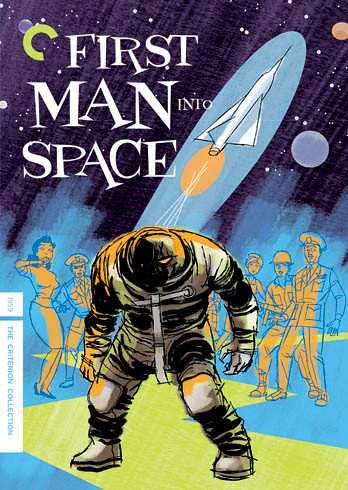
Monsters and Madmen is an unusual but welcome addition to the collection. It is a solid representation of a very specific kind of film from a very specific era in film history. While many of the movies from this era have become extremely campy with passing time, even the rudimentary effects of The Atomic Submarine and the ridiculous costume in First Man into Space are easy to ignore because you are invested in the story and more amazed by the filmmakers' sheer (perhaps misguided) confidence to pull it off.

Of the four films, I enjoyed Bennet's more than Day's three. Not only did The Atomic Submarine have the most enjoyable effects, the best lines, and some of the more interesting philosophical underpinnings, it was also for me the most fun by far. I loved the alien, whose look recalled The Simpsons and intentions recalled The Twilight Zone. I loved the ship, one of the most obvious models I've ever seen in a film, the kind of effect that makes you think Ed Wood wasn't so off the mark. Mostly, though, I loved the score, which was futurism at its wackiest.

Then there's The Haunted Strangler, which I actually think could be remade with a few tweaks to make the reveal a bit more believable. In fact, Karloff's performances in that film and Corridors of Blood helped carry the movies. The only one I didn't really like First Man into Space, most likely because the threat seems so unlikely to us now (the film was dated in just a few years). Still, a great collection, and while it's not the ideal set for me, it's the kind of thing that probably changed the lives of a few fellow nerds out there.

Links to individual reviews:

First Man into Space
The Atomic Submarine
The Haunted Strangler
Corridors of Blood

#367: The Haunted Strangler

(Robert Day, 1958)

 The Haunted Strangler has basically the exact same plot structure as Corridors of Blood. Boris Karloff plays a well-intentioned, well-respected man in the 1800s who is searching for a solution to a common problem and unwittingly becomes the villain. He has a younger protégé who is romantically involved with his younger relative in both, and both end in tragic finales.

On the other hand, The Haunted Strangler has a much more appealing concept behind it. Karloff is searching for a man who may have been the real killer in a serial spree twenty years earlier... though of course there's more to it than that. Karloff, for his part, gets to do some really great over the top physical work here, and the movie is a memorable one (and not just because the final victim in the initial spree was Martha Stewart!). Ultimately, though, these are the kind of movies that are more pleasurable than anything else, worthy distractions from more serious weighty topics (see the last month of Bergman viewings). I enjoyed it more than Corridors of Blood, but the genre itself fails to grab me beyond basic entertainment.

Wednesday, November 24, 2010

#366: The Atomic Submarine

(Spencer G. Bennet, 1959)

This was a real surprise. After two okay inclusions in the Monsters and Madmen boxset, here's a really spectacular film. Shot in an astonishing six days of principal photography, The Atomic Submarine is just as low budget and makeshift as First Man into Space, but crackles with the kind of imagination and subversive filmmaking that film didn't provide.

The two big standouts here are the effects and the music. The former are alternately hilarious and incredibly inventive, though often both. The submarine itself is so obviously a model that you keep expecting to see a hand holding it as it floats through the water, while the alien itself was clearly more of a substantial undertaking that certainly never feels real but is so appealing constructed that you hardly mind (it was also clearly the inspiration for the aliens on The Simpsons). Effects like this remind you what has been lost with the adoption of computer generated images. Instead of ingenuity, resourcefulness, and cunning, all you can see in effects now is work. You would never go to see Spiderman and ask, "How did they do that?" because the answer is now always "Computers." This has ideally benefited the storytelling by preventing you from being taken out of the movie - and in some instances where the effects are seamless, it certainly has. But in movies like The Atomic Submarine or The Thief of Bagdad, these effects had to be made on the fly, often by people who had never encountered these issues before. Part of this is that cinema was still relatively new in the 1950s and part of it was the lack of modern technology. But what it adds up to is an extremely entertaining experience. Then there is the music, which is played over most of the moments featuring the effects. This is some strange music, certainly of its space-age time but also somewhere between the most psychedelic 70s porn music and the laid-back cool of that era's Jazz. It's mindbending and totally awesome, the kind of score that reminds you how many buried treasures there are in films like this.

The story of The Atomic Submarine is no more impressive than the story of First Man into Space: a bunch of military guys and scientists go to the north pole to find out what is preventing ships from passing through, only to find an alien intent on colonizing the earth. The narration is done in a newsreel style that reminded me of Fishing with John more than it did newsreels. But the acting is actually not too shabby and the film is bursting with so much love for film and creativity despite its low-art origins that I don't think it's possible for even the most jaded viewer to avoid its spell.

One last thing, a character here is put on the submarine because a close family member was unable to go and he is the only other person who can operate a highly technical piece of machinery, so he goes reluctantly. Remind you of anything else?

Saturday, November 20, 2010

#365: First Man into Space

(Robert Day, 1959)

First Man into Space is one of the movies in the collection that is included not because it is great or especially relevant, but because it is not exceptional. Sure, it's made with a certain indefinable confidence, born not out of ambition but out of love for film. And yes, it is really astonishing that the filmmakers were able to pull off a fairly believable (if you ignore the now-cheesy slow-moving monster) sci-fi thriller with what probably amounted to a couple thousand dollars in finds. But there have been so many movies like First Man into Space made over the years that it's hard to really get excited about it. Finally, the movie is a bit of a drag, as it doesn't really get going until about an hour in (the movie is less than 90 minutes long) and you never really care that much about any of the characters.

When people talk about movies like First Man into Space, they often speak of the genre as a dead one, first made popular in the 1950s and dying out somewhere around the early 80s when Hollywood tightened up the distribution racket and films got more and more expensive to produce (especially films like this when audiences began to demand more and more sophisticated effects). But taking a look at recent sci-fi fare reveals that there are still movies being made in a somewhat similar fashion - the recent dud Skyline is a solid example of this. This makes films like First Man into Space interesting viewing for anyone who loves film history, but it doesn't improve their quality.

I'll freely admit I am not the audience for this kind of movie. The closest I probably come to loving a film like this would be either John Carpenter's remake The Thing or Brad Bird's homage The Iron Giant. But I can't imagine kids who would love a film like Skyline or something like the recent not-totally-terrible Pandorum would be able to sit through this movie, which is dated by its glacial plot and focus on morality tales in the name of pioneering science. It's not the special effects in the film that seem most dated, it's the style of entertainment.

Sunday, September 26, 2010

#368: Corridors of Blood

(Robert Day, 1959)

Not too much blood in the corridors here, but instead a rather surprisingly smart and taut thriller/drama about a good doctor in the 19th century before the invention of anesthesia gone crazy with a mad (but with our hindsight very realistic) quest to find a cure for pain during surgery. I have to admit I kept hoping for a little bit more awesomeness as the film careened towards its inevitably tragic conclusion. However, the fact that I was dreading this awesomeness is a testament to how much affection I began to feel towards Boris Karloff's character. This is a true testament to the film's ability to generate strong drama far beyond what I would have expected based on the packaging Criterion provides here, which is truly amazing but I feel does somewhat of a disservice to the film within.

Friday, February 19, 2010

#375: Green For Danger

(Sidney Gilliat, 1946)

Green for Danger is a ludicrous but entertaining film directed by the co-writer of The Lady Vanishes, another unlikely (though less so) thriller. Like that film, Green for Danger represents the essence of studio productions before the auteur theory took over post-1960s. It's populated wall to wall with charming men, beautiful women, and a deep secret that each hides, all lorded over by a wry inspector intent on cracking the case (and having a good time doing it).

However, the film didn't pull me in with the same immediacy as that earlier Hitchcock film. Part of that was the insanely unbelievable plot, but a lot of it came from the difficulty in following the characters, their various machinations, and just where the story was going. The basic whodunit was easy enough to discern, but much of the appeal of the characters was lost along the way. The film doesn't sizzle like The Lady Vanishes, partly because the relationships between the characters don't seem to change, partly because I didn't care enough about the people who eventually ended up being involved in the crime.

Green for Danger is the kind of film it would be a pleasure to find on TCM one night, and it is an interesting twist on the drawing room mystery so common in England. But beyond that, it doesn't have much to distinguish itself from the common mystery films of the era, highly enjoyable entertainment that is ultimately forgotten.

Wednesday, January 27, 2010

#358: Pandora's Box


(G.W. Pabst, 1929)

Pandora's Box is most famous for making its lead, Louise Brooks, an international star in the final days of silent films. The plot, about a woman who is sexually promiscuous and forces an editor to marry him before accidentally shooting him in a struggle, could easily be made today, but is not particularly interesting. So I wasn't looking forward to the movie, but I ended up being pleasantly surprised. I wouldn't go so far as to call the film a classic, but it's a strong film with some really interesting filmmaking and a decidedly modern look at sexuality, complete with pimps, lesbians, and Jack the Ripper.

The best scene in the film is the scene of Lulu shooting her husband. In the lead up, there are two great shots: one of the husband appearing in a mirror behind her, and another of just the hand of her husband giving her the gun, with Lulu front and center in the shot. Both are reminiscent of the best German expressionism

One interesting thing in the essay for the film is how easily silent movies can be cut to mean other things:
In France, Pandora’s Box was reedited so that Alwa was Schön’s secretary and the countess became Lulu’s childhood friend. Lulu was found innocent and Jack the Ripper vanished altogether. Before the movie was shown in New York, its ending was improved to have Lulu join the Salvation Army. Small wonder that the New York Times deemed it “a disconnected melodrama.”
 Pretty weird.