(Claude Berri, 1967)
The Two of Us not only would not be made in Hollywood today, it would be laughed out of development offices everywhere. "Where's the third act?" they would say, adding that "it's like having a gun in the first act and not using it in the third," or some other misguidedly rendered cliche about what makes a proper movie. Indeed, the film does lack its crucial turn, the sole reason for its existence within a conventional narrative framework. The fundamental question is this: how can a boy who is Jewish go to live with a man who hates Jews under the pretense that he is not Jewish and have that lie stand beyond the final credits? Without this reveal, the movie loses its confrontational moment, the one that would elucidate its themes and lead to the inevitable conclusion of its characters arcs. Yet by ignoring this imperative, the movie becomes all the more revolutionary, a movie about average people who are never called on to rise above their place or sink to new depths. Its finally a movie about racism and its unavoidable complexity and compartmentalization.
The center of the film is Michel Simon, an actor that was by the time he took the role one of the great actors in French cinema, with a career that stretched back to the legendary L'Atalante. His character is an early prototype Archie Bunker, a man with a firmly entrenched world view that is quickly and loudly dying out around him. He's a conservative without power outside his "castle," just as Archie is. And like Archie, once you get past his antiquated, potentially dangerous worldview, he's a gentle and warm person, a decent person. It's the gap that is most profound here, mainly because the strain of racism Simon's character represents, anti-semitism in particular, was one of the most destructive in history. Despite his distance from the actual tragedy, his acceptance of the culture makes him a difficult character for French audiences in 1967, still struggling with the history of the Vichy government. Berri was apparently so concerned with this that he put a disclaimer at the beginning of the film essentially saying "oh, the silly innocence of a child." It's an unnecessary addition today, but indicates how unique the film was at the time. Today, it's unique for a different reason, that absence of shattered perceptions mentioned above. The addition of this realization - and what Simon's Grandpa would have done with it - might have made the film more conventionally satisfying, maybe even more emotionally powerful. But without, the film is much more realistic, which ultimately makes it more valuable and moving.
Showing posts with label 376-400. Show all posts
Tuesday, December 11, 2012
#388: The Two of Us
Friday, April 27, 2012
#384: Vengeance Is Mine
Vengeance Is Mine is a messy beast of a film, a sprawling neo-noir with a cold tone and a defiant narrative structure. Knowing only Imamura's other films in the collection - the triptych of Pigs, Pimps, & Prostitutes and The Pornographers - I was curious to see how Vengeance Is Mine - made a decade after those films and clearly focused on a male protagonist in a neo-noir context - would fit into his style. No surprise: there's plenty of gender and sexual politics here, from the killer's deserted wife desperate for her father-in-law's embrace to the lonely and abused innkeeper he slowly cons into his life before coldly strangling her to death in one of the most harrowing moments in the Collection. Imamura's eye towards the downtrodden and the overlooked remains ever-loyal, and consequently Vengeance Is Mine serves less as the crime docudrama it pretends to be and more as the confirmation of everything Imamura fears and loves about Japan, depicting the forgotten and the damned with equal objectivity.
I really loved the comparison of Imamura to Sam Fuller in the accompanying essay. Both directors produced work that walks the line between subversive and exploitative, and while Fuller could occasionally lapse into Freudian psychobabble, both directors were much more interested in shining a light on the overlooked questions of their respective societies than in answering them. Here, Imamura has taken a Fulleresque true crime story and made it his own - somewhat similar to what fellow new-wave Japanese director Nagisa Oshima did with the equally (if not exceedingly) disturbing In the Realm of the Senses just a few years previous.
Unlike Oshima, however, Imamura chooses to present his film as an unfocused (yet roughly linear) journey. Iwao is certainly the protagonist, but he's hardly the end goal. The finished product then is both confidently steered by a master at the top of his game and deceptively rudderless. This primarily stems from Imamura's refusal to take a stand against his protagonist or explain his motives with anything more than half-hearted flashbacks to travesties past. Throughout his other films in the collection, Imamura has shown no sympathy for Japanese men, and not much has changed here - no surprise when the film is about a charming lady killer that fascinated his nation. It makes for a dark epic that could easily seem unworthy of the journey required to digest it, but skates by on Imamura's supreme talent and irrepressibly twisted wit.
Thursday, February 2, 2012
#389: WR: Mysteries of the Organism
After watching Sweet Movie, Makavejev's follow-up to this more highly regarded film, I pretty much knew what to expect here: a bunch of freeform scenes tied together simply by association that confront the dual threats of capitalism and communism that clash with the sexual freedom demanded of the late 60s and early 70s. Spoiler alert: that's exactly what the movie is.
Maybe it's because I watched it after Sweet Movie so the novelty was lost, but I liked the later movie much more. Though both films have plenty of characters shouting their sexually tinged political statements into the air at no one and everyone in particular, WR: Mysteries of the Organism seems a little bit more weighed down with these moments, unable to merge form and content as seamlessly as Sweet Movie. And unlike a similarly unconventional biopic, Mishima (which looks like a by-the-numbers Hollywood blockbuster compared to this movie), I don't get a sense of the subject's beliefs or life through the specific choices in the film.
I get why these movies are in the collection, but I wonder how much relevance they have in the modern world, and I especially wonder how much audiences will connect with them once people who were born after the fall of the Berlin Wall begin to examine cinema more closely. This doesn't make the films any less worthy as historical artifacts, but it lessens their impact as timeless artistic statements.
Saturday, January 7, 2012
#386: Sansho the Bailiff
Over the course of this little journey of mine, there have been a handful of films about which I often wonder whether or not I gave them a fair shake. I certainly try to evaluate each movie on its own terms and give it time to sink in rather than casually check it off my list in a rote and emotionless factory-line manner - something which would seem to defeat the true purpose of watching all of these films and reduce it to some bragging point, seeing them just to say I have seen them. But occasionally a movie can hit me on the wrong day or I can miss some small moment or context and a great movie becomes a merely good one in my memory.
Mizoguchi's Ugetsu is one of those films - an oft-praised, extremely beautiful movie that I felt very b-plus/a-minus about after my first viewing. However, there remained a little seed in the back of my mind that kept telling me "you've missed something there! You didn't give it the chance it deserves!" Still, my lack of enthusiasm made me put off watching the director's other film in the collection, Sansho the Bailiff (he also has an Eclipse set and a crapload of stuff on Hulu, a handful of which I expect to see get actual releases). Mizoguchi's follow-up to Ugetsu is a folk story about a family torn apart by the father's moral stand, and it's a very different film from its predecessor. It's also a masterpiece, one of the most moving films of its era, and a simple but powerful message movie - it certainly makes me want to take another look at Ugetsu.
But this post isn't about Ugetsu, it's about Sansho the Bailiff. Set in medieval times, the film focuses on a brother and sister who are separated from their mother on the way to join their exiled father and sold into slavery. Though the film is initially about both of them, the early scene in which their father basically lays out the moral backbone of the film's story to the son is a big hint upfront that he is the true protagonist of the film. He, too, is the only character with any substantial internal arc, moving from innocent child to faithful - even vindictive - slave until he finally redeems himself on the path to reuniting with his heartbroken mother. Their final reunion is one of the great emotional peaks in the Collection, and Mizoguchi shoots it with a gentle, poetic touch that manages to combine the best of Ozu's light hand - something often identified as stereotypically Japanese - with a more impressionistic eye.
Much of the contrast between this moment and Ozu's work can be found in their settings. Ozu's characters are often tied to their cosmopolitan - or at least domestic - surroundings. They move across these spaces in gentle and unobtrusive ways, yet they are bound by them and the social responsibilities they represent. Even taking into account Sansho the Bailiff's earlier setting, the film clearly delineates between the sharp angles of the Japanese structure and the soft oneness of nature. The film is deeply spiritual - not in terms of personal faith, but instead in the grand tradition of social justice at the core of many of the essential teachings of Buddhism (and Christianity for that matter). But there's also a political undertone that is most apparent in the film's title - Mizoguchi has chosen to name the film after the slave holder who is essentially a bureaucrat without power and banally evil. This clear choice to shift a timeless and (at least nationally) well-recognized folk tale toward an emphasis on the nature of this side-character is a strong indication that Mizoguchi had more contemporary concerns in mind when making the film - namely, the Japanese role in World War II.
These more intellectual intentions - which could be explained by someone much more engaged with Japanese culture than I - don't take away at all from the core emotional impact of the film. This is of course as it should be; no movie that strives for greatness can let its message get in the way of its engagement with the audience or it ceases to be a film and becomes an intellectual exercise. The fact that Sansho the Bailiff succeeds on both levels is what makes it such a notable masterpiece, and it's what will keep me engaged with Mizoguchi's work long after I've checked every spine number off my list.
Sunday, January 1, 2012
#378: Fires on the Plain
...On the other hand, Fires on the Plain - Ichikawa's follow-up to The Burmese Harp - is one of the darkest war movies I have ever seen. It's also so violently anti-war as to seem nearly nihilistic, torn apart by the very notion that humans are capable of killing other humans. The film's ending - in which the protagonist, the tuberculosis-ridden Tamura, struggles and seemingly fails to continue his journey over the harsh landscape towards an abstract home - mirrors that of Kobayashi's The Human Condition, made the same year. Both films make the point that the nationalism and subservience to society which drove the Japanese war machine ultimately led to the isolation and defeat of each individual, symbolized by the respective protagonists stumbling towards infinity, completely alone and ultimately too exhausted to carry on (though in Tamura's case it is unclear whether or not a bullet has taken him down).
However, despite this larger driving force between the two endings, Kobayashi's socialist message ultimately leads the viewer towards optimism for the future - his Kaji is a noble sacrifice for the greater good that will triumph over the fascist military establishment, and the conclusion is a call to action. Ichikawa's film concludes nothing of the kind; there is no hope that comes from sacrifice, only more death and destruction. We are introduced to his protagonist with a slap to the face from a superior officer, yet the film doesn't intend to depict him as a relatable or even sympathetic character. Tamura never succumbs to the ultimate horror of conscious cannibalism, but he does shoot a woman in cold blood. Kaji's motivations are made abundantly clear in the first act of The Human Condition, and - stripped of everything else by cynicism and pure human need - his desire to get home to his wife is all that's left in his dying moment. Conversely, we know little to nothing about Tamura - not in an intentionally metaphoric way, as in some films which avoid naming their protagonist to make a point about universalism or anonymity, but in a cold and calculated way. War and starvation and depravity care little for the identities of men who perpetuate and inevitably fall victim to them.
Watching The Burmese Harp and Fires on the Plain back to back is an odd experience. Despite some similar technique, the two films are totally different, and it's hard to imagine that they were made by the same person, just three years apart. I think Criterion does them a disservice by syncing up their packaging, despite the shared topic of the aftermath of World War II in Southeast Asia (it's also odd that they gave Fires on the Plain the lower spine number, but it's obviously a minor point). Though I was much less impressed with The Burmese Harp, the two films stand on their own as grand statements about the nature of war and the impact of Japan's most significant defeat not only on its soldiers but on humanity.
#379: The Burmese Harp
The Burmese Harp is a complex movie delivering simple themes. It's based on a book originally published in a children's magazine in Japan, and this makes sense because - while the film is anti-war - it portrays pacifism as a higher calling and a great responsibility and sacrifice, as opposed to condemning war as a great evil.
The whitewash of the Japanese presence in Burma in the film doesn't seem as scandalous as it might because of this origin. Furthermore, comparing the film to similar Hollywood war films of the time makes it seem both less outrageous in its historical inaccuracies and more typical in its melodramatic heavy hand with regards to its themes. The protagonist's journey from soldier to monk certainly has realistic and complex moments that hint at the dark side of such a journey. But too much of the story seems devoted to the kind of straight-faced do-gooder style ethical stances that seem more at home in a Douglas Sirk film (where Sirk, of course, would slyly parody them).
Ichikawa was a studio journeyman before The Burmese Harp, making this film and its subsequent international success his opportunity to cross over into artistry - something he would capitalize on frequently afterwards. But here, he still seems very much encumbered by a desire to avoid challenging his audience. Despite its deeply religious and anti-war themes, The Burmese Harp ends up overly sentimental and toothless - more Saving Private Ryan than The Thin Red Line.
Friday, September 16, 2011
#392: Three Films by Hiroshi Teshigahara
This boxset collects the first three of four collaborations between Hiroshi Teshigahara and Kôbô Abe. The excluded film probably explains why it wasn't branded as the true collaborations that they are and is instead simply "three films," and it's not entirely clear why Criterion chose to ignore the fourth collaboration, 1968's The Man Without a Map, especially since that film remains unavailable in the US. The easy explanation would be that Teshigahara's fourth film finally gave in to modern trends and moved to Cinemascope and color, making the film aesthetically incongruent with the earlier films. Furthermore - though I have yet to see the film - its reputation is not as impressive as those of the three films collected here (then again, a film like Love on the Run managed to be included in the Antoine Doinel boxset, despite being greatly inferior to the earlier films in the series - though obviously that movie was more closely linked and essential to its series). Still, it would have been nice to see all four films collected here, particularly since the three films included are so accomplished and Teshigahara's oeuvre is so small.
Of the three movies, I don't think there's any doubt that the most impressive film is Woman in the Dunes. The film has certainly received more attention from Western critics than any of the director's other films, but don't hold that against it - it's as impressive thematically as it is visually, and the intense plotting complements the film's worldview impeccably. Still, Pitfall is just as entertaining - and could fill just as many philosophy theses. On the other hand, while Face of Another was extremely well made and equally interesting from a philosophical perspective, the protagonist's cold cynical demeanor - and the film's subservience to this sentiment - makes it a difficult viewing that isn't necessarily worthwhile.
Three Films by Hiroshi Teshigahara is another great boxset from Criterion. I'm not sure how many times I'd want to pull this out, but as a reference set it is a(n almost) complete look at a unique voice in Japanese cinema. Here are the individual reviews:
#393: Pitfall
#394: Woman in the Dunes
#395: The Face of Another
Saturday, September 10, 2011
#395: The Face of Another
(Hiroshi Teshigahara, 1966)
The Face of Another is the final film in Criterion's Teshigahara boxset and his third collaboration with novelist/screenwriter Kôbô Abe after The Woman in the Dunes and Pitfall. It's also my least favorite of the three, partially because its pitch-black tone leaves no room for optimism, but mainly because its protagonist is so soul-crushingly depressing. It's difficult to see what we would like about Mr. Okuyama, who spends the film constantly complaining about his (admittedly shitty) situation, ultimately bumming out everyone around him and guaranteeing his already resigned-to fate. It doesn't help that the immediately welcome face of the legendary Tatsuya Nakadai, playing Mr. Okuyama, is hidden under scars and gauze.
This is all a shame, because The Face of Another is strangely moving and Roeg-style beautiful. Teshigahara combines a modern formalism with striking abstract special effects, making it easily the flashiest of the three films represented in the boxset. A viewing alternates, then, between fascinating moments that strike at worthy themes of loneliness, alienation, and self-perception and frustrating stretches where those same themes feel like nails on a chalkboard.
Ultimately, I would say I liked The Face of Another, mainly because its well-intentioned investigation into the human condition is in fact successful and accomplished. But I wouldn't say it's an easy viewing, or even necessarily an enjoyable one.
Tuesday, September 6, 2011
#394: Woman in the Dunes
(Hiroshi Teshigahara, 1964)
Like Teshigahara's first film, the elusive Pitfall, Woman in the Dunes is a neo-realist allegory, a fable told in earth-bound cinematic language. But where Pitfall managed to tie its strange occurrences into the world around it, Woman in the Dunes creates a self-contained world, a purgatory literally within the earth.
The film begins in the real world, following a bug expert as he treks his way through the desert to find a rare beetle he can call his own. But even in these early scenes the film's star is the sand, shifting and undulating against a washed-out sky - later, it sticks to flesh as the heat closes in and the film's scope tightens. The movie is about sand like no other movie - it's erotic, it's threatening, it's futile, and finally it is life.
Woman in the Dunes is the first film that is mentioned when Teshigahara's name comes up, and this is not surprising. While I may have enjoyed Pitfall a touch more, the director's follow-up is sexual, philosophical, and incredibly alive with texture and grit - it's clearly a masterpiece. Where Pitfall had so many open windows to crawl out of its logic, Woman in the Dunes manages to gain status as a surreal epic while still being tight as hell. It's a thoroughly impressive feat, and I'm looking forward to watching this one again to see how it's all done.
Friday, September 2, 2011
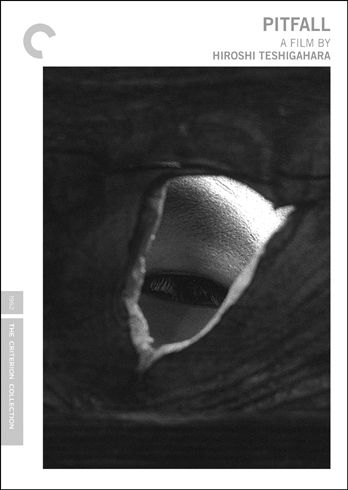
#393: Pitfall
(Hiroshi Teshigahara, 1962)
Pitfall is an investigation into the unseen forces in life. This means ghosts, for sure, but the film is not a ghost story. It's not about higher powers, either, but about the powerful and the powerless. It's a dark picture about a man in a white suit that doesn't bother to offer answers. Instead, it paints a picture of a world where we are all pawns in a larger game.
The only film of Teshigahara's I had seen before Pitfall was Antonio GaudÃ, the mostly silent documentary about the famous Spanish architect. That made me ill-prepared for his fiction work, and the first few moments of Pitfall are akin to being forced to walk with a different rhythm. This comparison could be applied to many filmmakers in the collection - most notably Ozu, Bresson, and Renais - but it feels especially apt here because Teshigahara's work is so simultaneously allegorical and ultra-realist. Pitfall is a film about a miner attempting to make a better life for himself and his son. Through this premise the film explores the economic difficulties of the work, how mines are tied to the larger society, and the place of unions and their management in that society. But it's not really about any of this, because the film could be set anywhere and effectively convey the same themes of alienation, despair, and powerlessness.
That all sounds very depressing, but the way Teshigahara constructs the film is invigorating. His camera alternates between dirty close-ups and sweeping vistas, and his tone is surprisingly warm. This might be the only ghost story I've seen that lacks any sense of haunting mysticism. Because of this, the fact that the movie ends without a typically satisfying conclusion was not dissatisfying, but purely logical. Pitfall is certainly a challenging film, but it's most impressive because Teshigahara is able to balance the opaqueness with a sense of unity. The man in the white suit might be coming for you, but at least he's coming for all of us.
Saturday, August 13, 2011
#397: Ivan's Childhood
The debut feature of a cinematic icon can sometimes be jarring, particularly if their oeuvre is relatively small. After watching Tarkovsky's debut, the beautiful, moving Ivan's Childhood, I can think of no better example of this phenomenon. Solaris has such a fully formed, wholly unique voice - such a sure hand at its controls - that the development of that voice seem inconceivable. Surely Tarkovsky's vision sprung from his subconscious fully formed.
Yet here is Ivan's Childhood: a brilliant and moving debut - possibly equal to Solaris in terms of pure beauty - but one where the director seems much more reliant upon influences than his own perspective. Tarkovsky - like Bresson, whose similarly singular voice was not completely realized until his third feature, Diary of a Country Priest - seems so stylistically distinct within film history that its hard to remember that (and I know this sounds strange) he was a person, at one point a young man trying to become a filmmaker. Tarkovsky himself said he made Ivan's Childhood as an experiment to see if he could cut it as a film director. It's a good thing he agreed with everyone else who has seen the film.
But beyond this observation, Ivan's Childhood is an effective war film regardless of who directed it. The story is a much more literal look at the effect of war on children than Forbidden Games. Ivan's journey is moving and immediate - of the three major Soviet works in the collection from this era that deal with WWII (The Cranes Are Flying and Ballad of a Soldier being the other two), this is certainly the most realistic and intense with regards to showing the true horrors of war. This includes documentary footage Tarkovsky incorporates into the movie. Plus, as I mentioned above, it's incredibly beautiful - this might be some of my favorite black and white cinematography that I've seen under the Criterion banner.
I still have a handful of Tarkovsky films to watch outside of the collection (I'm not sure why all of his films aren't on Criterion, since most of his later work is either unreleased in the US or available only in poor transfers). I've been putting them off until I can see them in theaters, since his work is so much more rewarding in this format. I'm sure Ivan's Childhood would also be even more effective on the big screen, but the degree to which I enjoyed this viewing (not to mention how much I love Solaris, which I just purchased on blu-ray and resides in my all-time top 10 list) makes me think I can't afford to wait to take in the rest of his work. If you haven't seen his Criterion selections (his first three features), I highly recommend you do so, beginning with this early, budding masterpiece.
Wednesday, August 3, 2011
#390: Sweet Movie
Is it weird that the filmmaker I was reminded of most while watching Sweet Movie was Tati? I guess nothing seems that weird after you've seen Sweet Movie, one of the most controversial movies in the collection.
Makavejev is best known for another Criterion entry - one I have yet to watch - WR: Mysteries of the Organism, but Sweet Movie is much more polarizing. Certainly I could see many people making a case that it is the worst movie in the collection, or at least the least deserving. I wouldn't be one of those people, not because I enjoyed seeing someone piss in someone else's mouth or always wanted to know what a penis dipped in gold looked like, but because I think all this madness has a purpose.
That purpose - so tied to the politics of the time, which were very real for Makavejev, who was forced from his own country after WR - may have less of an impact in the post-Cold War environment. But fascism and capitalism certainly still manage to reign supreme, so Sweet Movie rages on, even if its targets have moved to a different field. And despite this undeniably angry political message, that sense of Tati lingers on. It's not just in the sketch-style structure of the film, which features brief vignettes tied together with a handful of characters, but in the light touch of its humor. Despite being almost entirely sexual in nature, the jokes here tend towards visual cues and offbeat choreography with a heavy reliance on music and the modern world - two of Tati's favorite themes.
On top of the intense and worthwhile message wrapped in a weirdly light and meandering package there are some great moments in the film. The sex scene with the germaphobic American billionaire spraying down his virginal-beauty-pageant-winning bride is pretty hilarious. And if you haven't seen two people doing it in a pile of sugar before the woman stabs the man - causing him to laugh to death - you, um, haven't really lived? If you've read this far and you still want to see this movie, you will enjoy it. If not, well, maybe you should watch something a little less strangely explicit, like Antichrist. Isn't this all we ask of a movie, to be all that it can be? Sweet Movie delivers.
And by delivers, I mean has a scene where people shit on stage.
Monday, February 7, 2011
#377: When a Woman Ascends the Stairs
Like Nights of Cabiria, When a Woman Ascends the Stairs is about a woman who entertains men for a living and struggles to carve out her own happiness in life. Cabiria, of course, was a prostitute, while Keiko is merely a bar girl, the professional flirters (and potential mistresses) of Japanese executives in post-war Tokyo. Though "Mama," as she is called, takes a much more innocent approach to her task, the main purpose is the same: sublimate your own desires and preferences in order to satisfy the customer. Cabiria, too, was famously low-class, while Keiko must, in appearance anyway, be the image of luxury, the perfect mix of sexuality and capitalism. The comparison becomes especially apparent in both films' turning points, when (and this is quite the spoiler) a man each was depending on to lift her out of her situation is revealed as a false hope - in Cabiria's case a con-artist and thief, in Keiko's case a pathetic, married liar.
Despite two great performances from Hideko Takamine (who just passed away at the end of 2010) and the great Tatsuya Nakadai, the star of the film is director Mikio Naruse. The tone and pacing are simultaneously lyrical and hard-boiled, like Taxi Driver minus the crazy. The editing and shot selection is almost superhuman in its ability to deliver striking and meaningful moments in key pockets of the film without resorting to needlessly flashy moments elsewhere. This delivers what might be thought of as a traditionally Japanese aesthetic, but this is not a Ozu film. Instead, it's a full poem where a haiku would have been, fully aware of the noir, melodrama, and social message films that came before it, but not especially interested in belonging to any of them.
This is not to say that the film only works on a technical level. The emotional content here is very strong, and some parts will be especially sad for some people. Keiko's relationships are extremely broken - yet are they any more broken than the average relationships? The final scene in which Keiko returns to her job at the bar, finally resigned to her fate as a cog in the machine that will one day be discarded and replaced gives the film an ending that raises its aspirations to modern-day tragedy. Yet the irony of the moment is that what Keiko has endured isn't nearly as soul-crushing as what Cabiria has been through, and in fact Keiko has a much stronger potential to still come out on top at the end. After all, she is still relatively young and beautiful, and her moment to find a husband or make enough money to open her own bar isn't entirely out of reach. But because Fellini chooses to end his film on one of the great optimistic moments in film history, somehow we see the positive side of Cabiria's experience.With Keiko, it took me a few hours before I said, "Hey, she's not that much worse off than she was at the beginning of this thing."
This is probably due to the different approaches of the two filmmakers to their content, and the different contexts and intentions of the material. Nights of Cabiria is really just about one character, not about Rome or prostitutes or women (though because it's done so well, it's sort of about all of these things). When a Woman Ascends the Stairs is steeped in its time and place, almost totally eclipsed by gender dynamics, and often focused on its character's unique position in society. Keiko doesn't have hope at the end not because she isn't getting out of the system, but because the system continues. That's why the film cuts away so frequently to documentary-style shots of the normal geisha day and mindset, narrated by Takamine. These segments aren't to understand Keiko more thoroughly, but to understand this world completely. When Cabiria turns to the camera and smiles, it is the resiliency of humanity, its undying hope we see in her eyes. In this way, the two films are the reverse of their narrative focuses. Nights of Cabiria is universal, while When a Woman Ascends the Stairs remains singular, precise, and eternally in the present tense.
Wednesday, July 14, 2010
#380: The Naked City
(Jules Dassin, 1948)
Dassin's best work oozes surreal rebelliousness, but the real appeal of The Naked City is New York in all its splendid reality. The movie is set all over town, but the best scenes are on the lower east side where the murderer lives. Here are boys jumping through the streets, coffee shops on corners, towers stretching above the East River, all tied together with a plot best saved for an episode of early police procedural shows (which, of course, it would be when the film was turned into a long-running series in the early days of television).
When you say Dassin people think Rififi, and The Naked City wouldn't ever change that. But the film is notable for coining the term "There are 8 million stories in the naked city, this has been one of them." And the movie does have a certain clip to its plotting that never seems dull or even less than engaging. So it's a worthy addition to the catalog, and one of Dassin's more notable films.
(btw, the essay on this film is especially strong.)
Tuesday, June 22, 2010
#383: Brute Force
(Jules Dassin, 1947)
Dassin is an underrated American director with a unique perspective on cinema, one of the great noir directors that unfairly got pushed into the background during the blacklist era. Brute Force isn't the classic that, say, Rififi is, but it's a dark and, in its own way, epic take on the prison system, social power dynamics, and the human condition (no wonder this guy was blacklisted). Think Oz but a 40s noir movie where all the prisoners aren't such bad guys once you get to know them.
Yeah, there is a bit of melodrama here that I don't particularly need in my dark prison drama. But by the end, when the whole place is on fire, you have to think this isn't your average picture. Good stuff.
Sunday, March 21, 2010
#398: Les Enfants Terribles
(Jean-Pierre Melville, 1950)
Melville's second film is based on a Jean Cocteau novel, and it feels a lot more like a Cocteau film than a Melville film. Obviously, Melville had yet to find his calling as a crime filmmaker, and he was no doubt intimidated by Cocteau's presence on the film.
My biggest problem with the movie is simply how unlikable the two main characters of brother and sister are. This is simply just 100 minutes of two rotten, selfish young adults bickering back and forth until it's quite unbearable to take.
I'm still excited to watch this other Melville films on the list, and will chalk this one up to an early-career experiment in finding his voice, too often torn between his own instincts and those of the more established (yet much less up my alley) Cocteau.
Friday, February 26, 2010
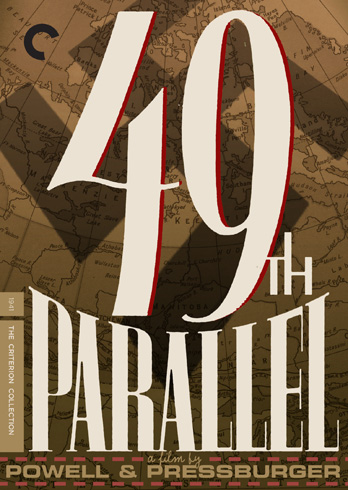
376: The 49th Parallel
(Michael Powell, 1941)
49th Parallel is part propaganda, part adventure thriller, yet it has one very unique twist. The movie is essentially The Great Escape, only you aren't supposed to want to root for the protagonists. In fact, the protagonists are Nazis, stranded in Canada, struggling to make it back to the (at the time neutral) United States.
This makes the movie a far more interesting one, in my opinion, than the movie Powell and Pressburger made two films later in The Life and Death of Colonel Blimp. The film is essentially episodic, as the Nazis meet different people along the way and slowly lose members of their group to death (at the hands of Canadians or, in one moving moment, their own hands) or capture. So the only through line in the film are the Nazis themselves, and yet you never root for them, as they are basically propaganda in the form of characters, quick to betray the people who they meet and even each other, devoted only to the Fuhrer, destined to be defeated. How many movies can you think of where the main characters are unlikable and unsympathetic? Now how many of those were made before 1970? 1950?
This would make the movie seem very revolutionary, if it wasn't for the fact that the Nazis speak the Queen's English - even to each other, alone - and are perfectly inconspicuous among Canadian crowds. This basically makes the entire concept of the movie unrealistic, since the language barrier is never addressed. I'm not sure how the conversation went where they thought, "Okay, let's just fucking do this whole thing in English." I doubt they even thought about it, of course. But I definitely think this movie could easily be updated for the modern war, involving terrorists being stuck in America away from central command... but now I'm getting ahead of Hollywood. I'm sure it's already in the works.
Sunday, February 7, 2010
#391: If....
(Lindsay Anderson, 1968)
Intellectually, I dug this movie, but the payoff wasn't enough to reward the work put in. And most of this movie does feel like work: the build up to the orgasmic violent outburst is mostly very British societal repression of the kind that only a British person can really appreciate.
In fact, this movie really was made for British people in the 60s struggling with the new world order. The movie dances between fantasy and reality effortlessly, fighting to merge the two in an anarchic dance. Malcolm McDowell is naturally excellent in his lead role, and certainly any fan of Kubrick's A Clockwork Orange needs to see this movie like Kubrick clearly saw it and found everything he was looking for to fill his own shocking vision.
But the movie didn't thrill me anything like that later film did, and feels much less timeless than that film, despite obvious efforts to the contrary (avoiding pop music, any seriously dated clothes, etc.). Despite these issues, I am certainly looking forward to watching This Sporting Life, as Anderson is clearly a challenging and engaging filmmaker.
Thursday, January 21, 2010
#385: Army of Shadows
(Jean-Pierre Melville, 1969)
Jean-Pierre Melville (who did indeed take his name from the American author) has been often overlooked among French directors of the 50s and 60s. Because he was not associated with the New Wave - and was in fact criticized by their Cahiers du Cinema for this very film - his films have only recently been rediscovered and reconsidered. Le Samurai is his most well-known film, and it is an inarguable masterpiece that transcends its gangster genre without looking down on it.
This film was only released in America in 2006, 37 years after it was made, thanks to the negative reaction it received from French critics. That turns out to be quite the travesty, as this is clearly another great film.
The film depicts the French resistance in a way that is both surreal and hyper-realistic to the point of being a procedural. Yet its core is a sense of fatalism and crushing sadness. I spent the two and a half hours watching this movie tense in ways normally reserved for thrillers, in awe of the beautiful color palette and preciseness of the direction, but mostly and persistently nagged by the question of whether or not I could do it. If the Nazis came to take over your country, what would you do?
Army of Shadows makes clear that there is no easy answer, that the cowardly thing means accepting your own inability to thrive, but the honorable thing means living with your own guilt at taking the steps necessary to survive. In one scene, terrifyingly realistic in its banality, three of the Resistance members argue over how to murder a traitor that is standing right in front of them, watching as they debate the safest way to snub out his life. The murder is committed in a simple and efficient manner. It is survival in this world, yet there is always a sense that these extraordinary circumstances do not forgive ordinary sins.
Perhaps the most polarizing scene in the film is an escape from a tunnel midway through. The reaction to this scene will most likely depend on how believable you need the movie to be. Is this a metaphorical look at what these fighters went through, not just battling the Germans, but battling their own sense of self? Or did these things really happen like Melville says they did? The main character is told to run towards the end of a tunnel with a group of prisoners, and if he reaches the wall first before the Germans had shot him with a machine gun, he would live to do the same thing the next day. He tells a comrade later he might not have run, and would have just stood there. Because of the other men, she asks? No, he says. Because he couldn't help but think about how sure the guard was that he would run, like a frightened rabbit.
Therein lies the question of Army of Shadows, a rare tragedy about heroism.
Monday, December 21, 2009
#382: Overlord
(Stuart Cooper, 1975)
This movie reminded me of three other movies I can remember, and one I can't put my finger on that also used a mix of archival footage and fictional narrative. The three I can remember are Saving Private Ryan, Full Metal Jacket, and Paths of Glory. The first two are obvious, as the film documents one soldier's journey from training to his first and last moment of battle at Normandy beach on D-Day. The latter came to mind frequently while watching because both films are about man's subversion to a system, the individual's loss of identity from a military tradition that values power or authority or even "the greater good" over a life.
Oddly enough, I found out after watching the film that John Alcott was the cinematographer on the film. Alcott worked on Kubrick's output during the 1970s, including Barry Lyndon, which was filmed using only natural light and candles, and is certainly one of the most startlingly beautiful films ever made. Though he didn't work on either of the Kubrick films that Overlord reminded me of, it makes sense that there would be a link between this film and Kubrick, who also loved documentary footage (he began his career as a photographer) and made three significant war films in his career.
The film itself is a bit slow and super depressing, but is unique in a bare bones sort of way. Destruction dominates, and the story of the soldier is so straightforward as to be drained of any real impact. We know from the beginning that he will die, so we don't really care when it happens. Perhaps it is this soul draining separation from death that the film was trying to achieve in the first place. Either way, it's an interesting film that is more unique than exemplary.
Subscribe to:
Posts (Atom)