Showing posts with label 101-125. Show all posts

Saturday, September 29, 2012

#113: Big Deal on Madonna Street

(Mario Monicelli, 1958)

Big Deal on Madonna Street sits in an early, rare string of comedies in the Collection, bookended by Tati's great Hulot films and the sparkling screwball classic My Man Godfrey. The film is also the first Italian comedy in the collection (unless you count Nights of Cabiria, which anyone who has seen the final sequence should not), and it has not been joined by much company along the way. This shouldn't be much of a surprise: most Italian comedy is pretty brutal. I don't want to pile onto the Roberto Benigni-trashing bandwagon, but broad physical humor that emphasizes exaggerated caricatures in ludicrous situations gets old pretty fast.

Big Deal on Madonna Street walks the tightrope, though, and even with a few real close calls manages to make it to the other side. This is mostly because the performances are believable and mindful of keeping the characters grounded in the reality of their environment. Monicelli, who would later make the worthwhile recent Criterion addition The Organizer, certainly has a bit of that social consciousness in mind here, even if it's being used in the service of comedy. Not that this would ever be mistaken for a message picture - the film serves only to make the viewer laugh, and it got me enough times that I enjoyed watching it.

Where Big Deal on Madonna Street came up short for me was its reputation as a noir satire. The movie clearly had ancillary noir products like Rififi in mind, but that film straddled the heist and noir worlds very effectively. Big Deal on Madonna Street lacks any of the noir elements that might make it a more compelling parody of the genre. Without this edge, the film is simply a bumbling thieves farce - albeit one of the first. Many of the movies that have come after it were influenced by this, but I happened to like them better. The film ends up being a pretty brilliant, almost archetypal premise for a movie done fairly well, which makes for a worthwhile Criterion entry but not necessarily classic status.

Friday, September 14, 2012

#124: Carl Theodor Dreyer Box Set

(Carl Theodor Dreyer, 1943-1964)

I was about to write that this is a love-it-or-hate-it boxset, but I wrote this instead because if you hate these Dreyer films, but love cinema, you really need to watch them again. And again. And again until you get them right. Even if Ordet is not especially my type of film thematically speaking, all three of these masterpieces are stunning cinematic accomplishments. They should be required viewing for anyone interested in film.

Of the three (and I'm not counting the documentary about Dreyer that comes with this set), my favorite was undoubtedly Gertrud. This is true not just because it was the most interesting to me from a plot perspective (and dwelled the least on overtly religious elements), but because the films seemed progressively more technically accomplished - an impressive, almost unimaginable feat considering how well-executed Day of Wrath is. Although there are a great many filmmakers who are easily identifiable by their signature style, Dreyer's appears to me to be the least easily replicated. There are probably only a handful of films in history that could not have been made by any other director. Gertrud is quite simply impossible to imagine without Dreyer's hand, not because it would be different in tone, less pronounced in its visual style, or thematically altered, but because it would very clearly cease to be the film that it is in any regard. Gertrud is practically about Dreyer as a director, yet he never overshadows what's on screen. It's a brilliant, brilliant movie.

Still, they are all brilliant, and while this isn't my favorite boxset in the collection, it's probably the first one I'd give to someone who told me they wanted to become a serious cinephile. Dreyer doesn't quite reach the apex of film as an artform for me, but he just might be the purest representation of the auteur and film's ability to manifest its creator's inexplicable spirituality.

Links to the individual reviews:

Day of Wrath
Ordet
Gertrud
My Metier

Tuesday, May 8, 2012

#125: Day of Wrath

(Carl Th. Dreyer, 1943)

Day of Wrath is a dark movie about characters filled with rage, spite, and crushing guilt. To the casual viewer (if there can be a casual viewer of Day of Wrath), the film might seem like the typical Christian picture, meant to force the viewer to atone for his or her own sins and focused intently on the penitence necessary to walk the path of God. It's exactly the opposite: an angry rejection of religious zeal and timeless indictment of both authority and the way women are treated. However, Day of Wrath is not an intentionally political film. Instead, its success as a film is confirmation that all art is political - that any confrontation of the nature of humanity and the society it created must speak to the structures and mores of its creator's world.

Nothing good happens in Day of Wrath. An innocent woman is burned at the stake, accused of being a witch, while another has been unwillingly taken as an older man's wife so that her mother was able to avoid the same fate. The wife falls in love with her husband's son, a weak and guilt-wracked individual who we realize quickly has no hope of being her savior. Finally, these characters get what's coming to them, whether they deserve it or not.

But despite the austere setting and dark subject matter, Day of Wrath is surprisingly engaging. This is partially because the film's simplistic plotting and tragic structure recall the melodramas of earlier times (especially silent films like Sunrise), but it's mainly because Dreyer's unique visual style and honest depictions of adult themes point towards modern filmmaking. Day of Wrath might look older than it is (and this is not Criterion's best print) but it feels a decade or two younger. That its witch-trial setting pointed towards The Crucible a decade later should be no surprise, and the reason why Dreyer, often overlooked by cineastes and critics, is so beloved by actual directors and cinematographers is clear from this film alone. With two more films in this collection (plus a documentary about Dreyer), I'm looking forward to delving further into his work.

Wednesday, July 13, 2011

#122: Salesman

(David Maysles, Albert Maysles, and Charlotte Zwerin, 1968)

Good lord, what a depressing movie. The Maysles brothers have made a number of other rough films, two of which - Gimme Shelter and Grey Gardens - are represented in the collection. But none of the films I've seen from them compare to Salesman, which depicts a group of door-to-door bible salesmen. These men - straight out of Death of a Salesman or Glengarry Glen Ross, only worse - are alternately pathetic and predatory. They live horrible lives barely scraping by in seedy hotel rooms conning poor and ignorant people out of their desperately needed money (the bibles cost around 300 dollars in today's money).

I guess the question to ask would be is it worth it? As a sharp critique of its subject and an examination of American capitalism at a turning point (when this type of con was dying out - it would eventually move to television on infomercials and HSN) the film is quite successful, but as a viewing experience I'm not so sure I would recommend the film. It can be oddly entrancing to watch a man bulldoze a weaker mark right in front of you - and it has the kind of power pieces like the two mentioned above can't produce with fictional situations. However, the train wreck quality of the film is undeniable, making this uneasy viewing for people with a heart. Ultimately, we can all be thankful that this sort of industry is now marginalized if not mostly eliminated (as far as I know), even as people continue to con people out of their money based on their faith. It's hard to imagine anything more cynical, and watching it unfold in front of you isn't exactly an enjoyable experience, regardless of the quality of the work.

Friday, July 8, 2011

#104: Double Suicide

(Masahiro Shinoda, 1969)

Spoiler alert - that's the final image of the film on the cover. Normally, that might be a problem. I'm definitely the kind of guy that doesn't like to know anything about a movie going in if I can help it. But here it seems appropriate because Double Suicide isn't really about the plot. Instead, it's about the thin line between artifice and reality and the unseen forces that guide our actions and lead us to our fates.

The film is based on a puppet play about a married man who falls in love with a prostitute. The two decide to commit suicide when they realize they cannot be together. Double Suicide opens as a depiction of the play, beginning with the puppeteers getting ready for the performance as someone whispers direction. Even as the characters become real, there is still evidence of the puppeteers all around, guiding the characters with hands and invisible strings.

Shinoda's work is a rebellious and subversive one, every bit as anti-authoritarian and radical as Kobayashi's Harakiri. The final moment of quiet death evokes the tragedy of the individual being destroyed by the system just as it presents suicide as the last refuge of freedom in a corrupt and totalitarian society.

Friday, April 22, 2011

#121: Billy Liar

(John Schlesinger, 1963)

Billy Liar is The Graduate four years earlier and set in small-town England. Actually, it's better than The Graduate. The film follows Billy Fisher, a professional underachiever who lives with his parents, sleepwalks his way through a meaningless job, and longs for a showbiz gig in the big city. To avoid sinking into a deep depression, Billy constructs elaborate fictions, some of which he keeps to himself, others which he shares with other people. Billy is engaged to two different girls, hiding a mild embezzlement scheme from his employer, and convincing everyone that his train finally came in and he's going to write for a big comic in London. Naturally, nothing goes as planned.

I'm going to admit a number of embarrassing things in succession: I had no idea John Schlesinger made such a splash in England before making the best picture winning Midnight Cowboy; I initially had thought Alec Guinness was in this movie; and I expected to find it moderately amusing at best. I was way off on all three counts, and the movie turned into one of those most pleasant surprises: the unexpected masterpiece. The film has a wry sense of humor in the most appealingly British way, and it's shot beautifully - this is, by the way, one of Criterion's best early transfers that I've seen, though it is now out of print. But the real appeal of the film is its vivid portrayal of Billy which I became totally invested in and consequently moved by.


Billy Liar, like The Graduate after it, is meant to be relatable to its audience. But despite the early moments when Dustin Hoffman returns from college to face his parents and their friends, Mike Nichols's film seems much more about my parents than about me. Maybe it's too iconic for me to see the film as anything but a representation of its time, whereas I am able to see Billy Liar shed of any baggage the canon might impart. The movie then feels much more universal, and while I can't entirely relate with the degree to which Billy struggles with his fears, I can see in it a fundamental challenge of youth as it slowly melts away and becomes regrets.

I often think about the difference between films made regarding the beginning of life and films regarding the end of it. I think the former are more appealing to viewers for two reasons. The first is that everyone can compare their own experience to the experience of the young people in the film, because everyone has been a young person, but not everyone has yet been in the twilight of their life. The second is that young people are inevitably concerned with the future, creating new realities to shape their world and the world of people in future generations. This makes movies about young people feel fresh when they are created, because the experience of that generation - whether it's depicted in Rebel Without a Cause or Fast Times at Ridgemont High - is unique and immediately relevant. In contrast, movies about old people are almost always looking back to the past, grappling with larger philosophical issues - think Wild Strawberries or On Golden Pond. This makes them timeless, but it also makes them feel less alive: the latter two films I mentioned are certainly quieter, more subtle explorations of humanity than the bombastic teenage melodramas made in relatively contemporary times.

This is all to say that Billy Liar depicts a moment in youth culture to which I have little connection and every connection. The way the characters behave is totally foreign, but why they behave that way is perhaps the most immediately accessible and personal motivations film can represent. When Billy makes mistakes or has the chance to make the right choice for his life, we feel that much stronger because we see our own crossroads and wonder what might have been. On a more universal level, we are able to understand so much more where a generation found themselves in a crumbling empire just after a world war turned their futures upside-down. This combination makes Billy Liar exhilarating viewing for anyone who grew up.

Side note: this is one of the worst Criterion covers ever. It makes the film seem like a Jerry Lewis movie, and the tone doesn't fit at all with the film. Based on a quick search it appears to have been created before Criterion got the rights to the film. As someone who is a self-confessed unquestioning fanboy of Criterion's design aesthetic, I'd like to use this as an excuse for its use here.

Wednesday, April 6, 2011

#109: The Scarlet Empress

(Josef von Sternberg, 1934)

The Scarlet Empress is certainly one of the most dazzling films in history. Created towards the end of Josef von Sternberg's torrid cinematic love affair with Marlene Dietrich's face, the film is at once bizarrely funny and surprisingly intense. It's also dripping with sexuality - code-flaunting, exhilarating, hilarious sexuality, the kind you only hear about in movies. The film charts the course of Catherine the Great of Russia, from little girl to her first moments as Empress after taking the throne from her dimwitted husband. Dietrich plays two roles in the film: first she is the cherubic, wide-eyed young woman who comes to Moscow to be married and honor her husband until she abruptly and effortlessly transitions into the confident sexual predator, enjoying her life and  intent on keeping it that way. Both are infused with their own brand of sexuality, and both are endlessly fun to watch.

Made in the early years of talkies, the film has long stretches which could easily be silent. There are a great number of cards, and whole sequences, most notably the wedding scene, are accomplished without dialogue. But neither element feels out of balance, and visually the film manages to stay interesting regardless of the presence of words. Stylistically, Sternberg's film might best be compared to the beautiful and foreboding first part of Eisenstein's Ivan the Terrible. This earlier film is beautifully shot, with oversized sets and shadows thrown into the unlikeliest of corners. But aside from the royal Russian setting, everything else in the film couldn't be further from that straight-faced epic. Sternberg delivers a tone that seems to be a cross between Max Ophüls at his most flamboyant and the Marx Brothers at their most abstract. His camera has only one purpose - to present Dietrich at her most iconically beautiful - and it seems invented for this sole purpose, seemingly capturing moments without her in equally striking compositions only by chance. He sticks a crass, grumpy old mother out of a Lubitsch or Capra movie into the role of the elder Empress, Dietrich's mother-in-law, while her lover seems to be channeling Clark Gable (who the very same year made the perfect It Happened One Night).

Dietrich plays her part in this tribute to herself masterfully - really, some of the great moments in the first half century of cinema are here. How can you wrong with a line like "Entirely too many man love my hair," really? Dietrich's second half is so outrageous that many viewers will see The Scarlet Empress as camp. There's no denying it works on this level - everyone here is just having too much fun. But the spectacle of the thing, infused into everything from the sets and their towering gargoyles to the music and the sly cards that transition between scenes (let's just say the film has some mean things to say about Russia), is where the true pleasure of the film reveals itself. Obviously movies like this are simply not made anymore, but there isn't even a contemporary equivalent for the film. The Scarlet Empress is everything but the kitchen sink filmmaking at its most exciting and inventive.

Friday, March 25, 2011

#120: How to Get Ahead in Advertising

(Bruce Robinson, 1988)

How to Get Ahead in Advertising is certainly one of the stranger films in the Collection. It's also one of the funniest, thanks in large part to Richard E. Grant's performance. The actor was also central to Robinson's other Criterion entry, the equally dark and biting Withnail and I, and he throws himself into this role with a kind of energy that would seem reckless in any other movie, but seems almost certainly essential here.

Grant plays the kind of cynical ad executive we've seen plenty of times before in films before and after this late-80s entry. The difference comes when a creative blockage on a pimple cream account turns into an actual boil on the side of his neck, which begins to grow and grow until it eventually sprouts hair, then eyes, then begins talking. Eventually, this new head takes over, and Grant's original consciousness is left to cling to life as a boil on the side of his alter-ego's neck.

This all sounds rather Cronenbergian, but every aspect of the film is so infused with a John Waters-like campy wink that it would be difficult to imagine anyone being scared or disturbed by the film. There are, admittedly, some vague comparisons to be made between this film and Cronenberg's earlier Videodrome (also in the Collection, and in mine), most notably a totally unlikable anti-hero devoted to underestimating the public, the alteration of the human body - almost always present in Cronenberg's films - and the use of videotape. But Robinson wants to explore the psychological and sociological implications of modern advertising almost exclusively, and the second head Grant's character develops is merely a means to an end (and a clever play on the film's title).

How to Get Ahead in Advertising is not a subtle film, and your response to it will most likely depend on whether or not you can bear the constant harping on the film's theme, which is, I'm sure quite self-consciously, incessant. But Grant's complete faith in the material won me over, and I was laughing too much to bother getting annoyed at being preached to. Anyway, if a product isn't low in something, it must be high in something else, right?

Monday, March 14, 2011

#106: Coup de Torchon

(Bertrand Tavernier, 1981)

My favorite fiction book of all time is Albert Camus's The Stranger. This is partially because I love Camus's style, but mainly because I am fascinated by his narrator and invigorated by his conclusions. "For the first time, in that night alive with signs and stars, I opened myself to the gentle indifference of the world," Camus writes in the book's final pages. It's a powerful concept that can be read as either nihilistic or rigidly moralist (or at least humanist). Life is almost literally what you make of it.

I bring up The Stranger because Coup de Torchon lends itself so well to this philosophy. Though the book upon which the film was based (Pop. 1280 by pulp hero Jim Thompson) was actually written before The Stranger, Tavernier's film is relocated to French-occupied West Africa pre-WWII, and has been infused with a rich steeping of existentialism. The film's protagonist, Lucien, is the police chief of a small backwater town, and is made to be the butt of all jokes (in one case, literally, as his superior kicks him in the ass to demonstrate how Lucien should handle some pimps who have made it their duty to humiliate him). Lucien dutifully plays the part, until one day he decides to begin killing off all of the horrible people in his town.

Pop. 1280 was written in first person, which forces the viewer to be sympathetic to the protagonist's actions. This is difficult to achieve in film, especially without first-person narration (an overused device if there ever was one - most modern films that use it could eliminate it from the final cut and nothing would be different). Tavernier doesn't quite elicit sympathy for his Lucien - I'm not even sure he (or Lucien himself, for that matter) really wants it - but he is able to let his protagonist's world take form in an increasingly claustrophobic way. By the time Lucien's really dastardly deeds are done, it's hard to hold anyone accountable for anything in this morally bankrupt environment. Even though the film is not being presented from Lucien's perspective, it's as if Lucien himself had made the film.

This is why the film seems so darkly funny. We don't cringe as bodies pile up because people are discharged with such a routine shrug of violence and revenge. This tone isn't designed to entertain, as it was so perfectly in a film like Kind Hearts and Coronets, but instead to illuminate our uncomfortable relationship with our own morality and mortality. The fact that we feel nothing is meant to make us feel uncomfortable.

And yet the film seems to imply these people are already dead. This final moment of French imperialism stands in for any instance of sustained societal wrongs, when absurdity and morally-corrupt rebellion seems like the only option (the less complicated but still admirable Stander comes to mind). The idea that prejudice - most frequently racism or sexism - destroys the perpetrator as much as if not more than the victim is not a new concept, and wasn't even when Coup de Torchon was made. But the film introduces this concept in such a non-judgmental way that its real sentiments might not be entirely clear.

I read a couple of contemporary reviews of the film after watching it that were negative. The core takeaway seems to be the film's emptiness, a lack of soul that might hold it together as its world crumbles around the viewer. This seems to me to be precisely the point of the film, and what ties it to The Stranger in such a fascinating way. Lucien, I think, is meant to be all of us and none of us. Put into such a hateful, broken society in a position devoid of power or the ability to make a difference, we want to believe we would be like him almost as much as we fear we could become him. We hope for the camera to judge him so we do not have to. Instead, all we get is a gentle indifference.

Monday, February 21, 2011

#102: The Discreet Charm of the Bourgeoisie

(Luis Buñuel, 1972)

Finally! After a fairly uninspired journey through Buñuel's catalog, I've at long last arrived at a masterpiece. I always hate to agree with the Academy Awards, but The Discreet Charm of the Bourgeoisie is a great film, and worthy of its win for Best Foreign Film of 1972 (although technically I don't agree with the statement, as Solaris was also released that year, but not submitted by the USSR). The film doesn't do anything significantly different from Buñuel's previous work, it just all comes together in a supremely entertaining fashion.

The basic concept of the movie is easily compared to The Exterminating Angel. Both films are about "respectable" members of society who attend a dinner party, but the earlier film prevents the attendees from leaving said party, while the hapless inhabitants of The Discreet Charm of the Bourgeoisie can never even get started. Every plan for dinner, every moment before taking a bite, even most moments involving sexual release, is interrupted for increasingly ridiculous and surreal reasons.

Despite this obvious comparison, the film of which I was most reminded was A Woman Is a Woman, which I watched (and loved) early in this project. Both films are completely unconcerned with the illusions of filmmaking, and would much prefer to dialogue with the viewer. At one point in Buñuel's film, a man named Sénéchal wakes up from a dream which we had previously thought was reality. Later on in the film, another moment turns out to be a dream from which someone else wakes up. "I was dreaming," the man says, "No, wait, I was dreaming that Sénéchal was dreaming and woke up, and then I was dreaming." Elsewhere, at keys moments where a character reveals something crucial, a plane conveniently flies overhead and we are kept in the dark.

Buñuel unsurprisingly tosses in some digs at the Catholic church, with a bishop who gets off on tending to a wealthy couple's garden, but these moments seem much more light-hearted than preachy. This is probably because everything here is so over the top that even as he depicts these horrible people in their horrible bourgeois lives you can't help but be sucked in by the sheer glee he is taking in skewering it all. There's simply no time to be weighed down by Buñuel's hang ups and heavy-handed politics. Which is most likely why such a politically aware film and relevant social commentary can be so easily tied to what is probably Godard's slightest work of the 60s and 70s, instead of to a film like Pierrot Le Fou, which is more relevant thematically.

Interestingly, the comparison between Godard and Buñuel can be extended beyond these two films fairly easily. According to some people (I haven't seen a direct quote), Buñuel was heavily influenced by Godard's political films while making The Discreet Charm of the Bourgeoisie and its surrounding films. Like Godard, Buñuel never made a film carelessly, and always had his overall thematic concerns in mind. This was primarily because both directors were so self-obsessed as to be constantly reflecting their own psychological wounds and personal dreams on the big screen (which is probably what made them both great artists). But they were also highly political filmmakers, in both their thematic and structural concerns. Most of the time, this dates their movies and hurts the long-term broad impact of movies like Viridiana and Tout Va Bien. But when they hit upon a specific and timeless theme (like in Contempt) or go broad enough (like in The Discreet Charm of the Bourgeoisie) the results can be more illuminating than just about any other director could produce.

Sunday, February 6, 2011

#117: Diary of a Chambermaid

(Luis Buñuel, 1964)

Diary of a Chambermaid is easily the most overtly angry Buñuel film I have seen so far, not because it is any more cynical or subversive than his other films, but because his consistent worldview is not covered up with the usual satire or outright humor of his other films. I don't mean to say that there aren't stabs at comedy here - most notably the old man's foot fetish which supposedly mirrored Buñuel's own fascination - but even many of the ironic or satiric moments seem so dark as to lose their pleasant zing.

Jeanne Moreau plays the chambermaid who arrives in a small French town, only to be thrown into the various rivalries and scandals of her employers, coworkers, and surrounding neighbors. The movie is saved from total depression - among other things - by Moreau, one of the great actresses of her era. Her guarded charm and the immediately believable way in which every character relates to her is entirely due to her screen presence (she performs similar magic in her greatest role, Catherine in Jules and Jim). She remains likable even when her character is most confusing and certainly not the pious angel some may have expected.

I didn't really understand Moreau's character entirely. Was she the stuck-up city girl everyone seemed to think she was? The truffle scene would seem to imply that was the case. But why would she be interested in marrying the general? More importantly, is she just interested in marrying Joseph so she can reveal him as the murderer of Claire? Her performance is so guarded that it was difficult for me to connect with her. Then again, you may be noticing a pattern in which it is difficult for me to connect with anyone in a Buñuel film.

Friday, December 24, 2010

#107: Mona Lisa

(Neil Jordan, 1986)

Mona Lisa belongs to two crudely constructed genres which generally don't thrill me: the performance film and the slice of vaguely noirish cinema in which naive men become exposed to the dark sexual habits to which women often fall victim. The latter - to which a massively wide-ranging quality of films belong, including everything from Taxi Driver to the recent joke/surprise hit Taken - can often be either oppressively dark or weirdly fetishistic. Taken, for example, revels in the male fantasy of protecting untainted girls from the evil grasp of the rest of the horny male sex, all while pretending (albeit very vaguely) to condemn conventional concepts of sex and gender power dynamics. It's a "have your cake and eat it, too" style of filmmaking that, sadly, can be easily well received by the general moviegoing public (worst of all, Taken was especially popular among women). On the other hand, Taxi Driver, of course, leads to the destruction of civilization, to the point where even any kind of redemption that can be taken from Travis Bickle's final moments is difficult to carry under the weight. (Side note: I feel I've been comparing really amazing movies to really awful movies a lot recently.)

Mona Lisa, fortunately, avoids both of these conclusions, instead depicting an entirely realistic and extremely moving climax which avoids both exploitation and hopelessness. A big part of this success can be attributed to Neil Jordan, who manages to make the film moody without being mannered, and generally paints a melancholy but redemptive picture of London as a noir capitol. But most of the success can go to Bob Hoskins, who is simply stunning and heartbreaking as George, an ex-con who slowly falls in love with the prostitute he's charged with driving around town to her various johns. There aren't a whole lot of performances that spring to mind that can compare to Hoskins here, who is understated and controlled where his character from The Long Good Friday was oversized and full of fire.

It's easy to compare the two movies, really, since both are British noir films starring (really, entirely focused on) Hoskins. But Mona Lisa has none of the religious baggage the earlier film had (here, I guess, it's mostly sexual) and though it lacks the energy that carried The Long Good Friday through to its climax, it makes up for it in personal stories that carry far more weight and simply feel more relatable. Even if it takes some time to get going, it's a very strong picture, one of Jordan's best, and even though I usually shy away from movies that center around one major performance, Hoskins makes Mona Lisa a must see.

Sunday, September 19, 2010

#123: Grey Gardens

(David Maysles, Albert Maysles, Ellen Hovde and Muffie Meyer, 1976)

Grey Gardens is a film that could easily degenerate into a discussion of the morality of exposure - and therefore exploitation - of sick people. Cinema by its very nature focuses attention on its subjects, and at its most simplistic level, there are only two approaches: glamorization and condemnation. Because the Maysles' took such a hands-off approach to Grey Gardens, the only conclusion (if one is to be negative about the portrayal of the Beales) is that they intended for Big and Little Edie to hang themselves with their own rope.

Certainly the mother and daughter are eccentric enough to do so. Torn between the genteel upbringing they both had and the squalor in which they both live, the two larger-than-life characters are so obviously disconnected from reality that they struggle to be believed as real people. Little Edie in particular is one of the most incredible characters ever put to film, giving the kind of performance that would get most actresses laughed out of a rehearsal. And yet here she is, not at all giving a performance but simply living her life.

I find it funny that a movie like this can be thought of as taking advantage of the misfit in society when I can't honestly imagine someone who entirely fits in in society enjoying the film. In fact, it's reputation as a midnight movie is a strong indication that it is precisely the people who struggle in mainstream society who see their own idiosyncrasies reflected in the Beales. 

Instead of being that (bad) documentary where people who are twisted and confused (and isn't that funny?), the movie is much more fascinated with these people, being both sympathetic and genuinely impressed with the arc of the lives of these women. It's also fundamentally about America, like all Maysles documentaries, in that it tells a story about class that makes mobility seem all the more likely, for better or worse. Grey Gardens, then, becomes a story not of exploitation or tragedy, but of uniqueness and missed opportunites - luck, really. The story of the ups and downs of the formerly ruling class, where modern America has no place for those who don't make their own way in the world, even if just to marry the right man or dance the right dance.

Thursday, July 15, 2010

#115: Rififi

(Jules Dassin, 1955)

There's a great interview with Dassin on the DVD for Rififi in which he tells a story about showing the film to a friend of his right after finishing it, being unsure of how the film would play. The first thing his friend said to him was, "Make this movie for the rest of your life." That's when Dassin knew the movie might be pretty good.

I hadn't seen Rififi for over ten years when I watched it this week. I remembered it being a great movie, but I didn't really remember just how good it was. Rififi is a perfect film, the kind of movie that is made maybe four or five times a decade, the kind of movie that will never, I mean never, did I mention NEVER, be surpassed as the greatest heist film ever made.

But really, that might be underselling the film. The climactic race through the streets of Paris is one of the great moments in cinema history - and that's not even discussing the heist itself. Both scenes, actually, have no dialog, and could have been made (though less efficiently) in the silent era and been just as effective. Yet the movie also thrills at every point in between, and dwells in both low and high art so effortlessly that it's hard to imagine a more perfect representation of the film's synthesis of American and French filmmaking. Quite simply, Rififi is one of the best movies on Criterion, an undeniable masterpiece.

Tuesday, May 11, 2010

#108: The Rock

(Michael Bay, 1996)

The Rock is everything you want it to be and nothing more than you would expect. It's an action movie made in the heart of the 90s, and it typifies the decade's updated tropes for America's broadest genre: unlike similar non-stop testosterone-pumped popcorn garbage (I mean that as a compliment) from the 80s, The Rock is unexpectedly complex. So the villains are more nuanced, the direction flashier but more sophisticated (with the obvious exception of Verhoeven), and the main characters are played by genuinely great actors like Sean Connery, Ed Harris, and Nic Cage (yeah, I said it), fresh off his Oscar for Leaving Las Vegas, a slightly different film.

But then again, the movie treads over all of the usual ground that has made the genre so often maligned. Here is terrible (great) dialog like "losers are always whining about giving it their best shot. Winners go home and fuck the prom queen." There are ridiculous character traits that are passed off as character development, like Cage receiving a Beatles LP at his office because his girlfriend would be mad he spent so much money on one record. And, of course, everywhere are the ridiculous, never-ending action sequences which pop up in the most inexplicable places in the most absurdly super-sized ways. How great is it that not only was there a hummer for Connery to jump into, but Cage got to find a lamborghini rolling down the street?

Still, there's a reason why people love to complain that Armageddon is part of the Criterion Collection, while few people ever say peep about its older brother The Rock sitting right next to it. The movie succeeds at its end goal better than maybe any other mainstream action film in the decade (only another Cage film, Face/Off, comes to mind as competition), mostly because it plays everything so straight-faced and uses the action sequences in such giddy, inoffensive ways that you can't help but be caught up in it.

Perhaps the only flaw in the film is that, in trying to make Harris a more complex character, the filmmakers made him a much less compelling villain because, well, he's kind of right. How wrong would it be for America to use its illegal funds to pay settlements to families of soldiers who lost their lives in secret missions? So maybe complexity in action films isn't just usually not necessary, but actually detrimental to the enjoyment of the movie. Or maybe the admirable attempt here was just too half-hearted. Either way, when a cable car slides down the streets of San Francisco and bursts into flames as it explodes, who really cares whether we see shades of gray in the baddies?

Tuesday, February 16, 2010

#114: My Man Godfrey

(Gregory La Cava, 1936)

I obviously do not share the common view among people my age that any movie before The Godfather is an "old movie" and therefore uninteresting. However, one line of complaint that I have a hard time arguing is the negative depiction of women in films made before 1960. Women in these films are often shrill, highly emotional, and unreasonable, prone to crying and fainting at the slightest conflict (a notable exception to this rule, among many, is Rosalind Russel in the incomparable His Girl Friday; ironically, this role was written for a man in the original play).

I mention this after watching My Man Godfrey because the film features one of the all-time great hysterical female performances by Carole Lombard. One of the best female stars of the 30s, Lombard has seldom been matched by any of the screwball heroines that followed her (she died in a plane crash in 1942, while still very much in demand), and here she flops and stomps gracefully through scene after scene. This is the second time I've seen the film, and while I had always remembered it as a strong entry in the screwball category (and a film that flirts with the social commentary that would blossom in Criterion selection Sullivan's Travels), Lombard's performance was an extremely pleasant surprise. Instead of playing her character as the common flighty woman, the actress makes her seem real and unique, a character who has created her fits and tantrums not through the feminine stereotypes of manipulation and emotional immaturity, but through her own spoiled life experience, combined with a powerful personality that is at once off-putting and strangely appealing (something with which Powell's Godfrey obviously agrees).

The movie manages to delight in numerous other ways, from the smart-ass maid to the grumbling father, played by Eugene Pallette, one of my all-time favorite character actors. La Cava would never be mistaken for Sturges, or Lubitsch or Hawks, but sometimes a common Hollywood product like this comes off as effortlessly as the work by those masters (it happens less often now, of course). The fact that he has Powell and, especially, Lombard along for the ride only makes it that much more fun.

Side note: Any chance the horse in the library was an influence on the tiger in the bathroom in The Hangover?

Friday, January 8, 2010

#116: Hidden Fortress


(Akira Kurosawa, 1958)

Why won't anyone listen to Toshiro Mifune? Just like in the later film Sanjuro, Mifune has to deal with shitty guys that don't listen to him and fuck up his shit for two hours. If I met Toshiro Mifune and he was like, "Yo, I think we should go this way, and don't say anything," I would go that way and shut the fuck up.

The Hidden Fortress is Star Wars from the perspective of RJD2 and C3PO if instead of being robots they were dicks. It's also Star Wars if Star Wars was way more awesome and had less merchandising. While I still prefer three or four other Kurosawa movies, this is a fine action-adventure film that includes one of the most awesome Mifune scenes I've seen. The star rides after a couple of bad guy on horseback, sword drawn, and takes them down. Then he gets off the horse, surrounded by bad guys, and challenges another samurai to a duel. They have an awesome fight (with spears!) and Mifune wins (duh). This guy is fucking awesome. Listen to him.

Sunday, December 27, 2009

#110: M. Hulot's Holiday


(Jaques Tati, 1953)

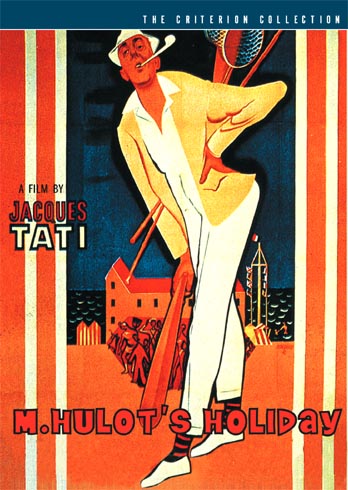
Another Tati film, the first featuring Hulot (yes, I watched them in reverse order). This was my least favorite, as it had fewer moments of elaborately choreographed gags and sets that lacked the surreal appeal of future Tati films. In their place are jokes much more directly influenced by their silent film ancestors. Hulot is a Magoo style character, someone who inadvertently gets into trouble and then magically untangles himself through no fault of his own. This can be extremely clever when it works, but an hour and a half is a long stretch to fill with successful gags. Unlike Playtime and Mon Oncle, M. Hulot's Holiday doesn't have the visual appeal to sustain interest through these moments.

#111: Mon Oncle


(Jaques Tati, 1958)

Movies made before VHS - and certainly before television - must be viewed at home under a different light. In the eyes of the filmmaker, their movie was meant to be seen on a big screen, for as long as the movie would be seen. There are some movies that don't mind being shrunk down to size, though they are all better on a big screen. But then there are films that simply do not translate. 2001: A Space Odyssey is virtually unwatchable on a television. Lawrence of Arabia seems small and dull. Silent classics such as Sunrise and Metropolis lose their sense of spectacle almost entirely. If I had never seen Solaris in theaters, it would most likely not currently reside in my top ten favorite films of all time list.

Playtime, Tati's third film starring himself as M. Hulot, is a masterpiece, and it's one of my favorite films to see on the big screen. I suspect Mon Oncle would also benefit greatly from a big screen presentation. It is hard, for example, to appreciate the elaborate process of climbing and descending stairs that Hulot goes through in his apartment building from a single long shot unless the details are made that much pleasing and accessible.

Still, it is an undeniably enjoyable moment, and there are plenty of others here. But without many words and even less plot, the film can feel drawn out at home, where patience is in higher demand. This is a strong film - though it lacks the true brilliant spectacle of Playtime. It's just better served by its originally intended viewing location.