Showing posts with label 151-175. Show all posts

Saturday, October 20, 2012

#155: Tokyo Olympiad

(Kon Ichikawa, 1965)

Tokyo Olympiad has been out of print for five years and typically runs you about $200 for a used copy. Even worse, there has been no new release on DVD for western audiences, making this the new Salo (pre-re-release of course) in terms of being nearly impossible to see through any legal means in the US. This is a shame, as it's one of the best sports journalism documentaries I've ever seen.

Choosing Ichikawa to film your Olympics - ostensibly to glorify Japan and its hosting at long last of the grand world games - was certainly an odd choice. It's very nearly like America hiring David Lynch to film the '96 games. Unsurprisingly, the Olympic committee got what they really should have expected, and heavily edited this nearly 3 hour epic to give it a more conventional feel. Criterion's restoration of the original work reveals just what you might expect from Ichikawa: a film much more concerned with the process - the pushing of the human body and mind to excel and how will interacts with physicality - than the outcome of any one sport.

The closest any segments get to a conventional depiction of the competition are the suspenseful pole vault duel that lasts into the night and the much duller women's volleyball face-off in which Japan wins the gold. The latter almost feels like Ichikawa forced it into the film to placate the homers that were looking for a rah-rah moment. The film shines much brighter when zeroing in on a runner's body, shown from the waist up gliding through mid-air, or a rifleman indenting his cheek as he leans over his weapon. These moments attain a sort of elementary beauty that is devoid of the marketing, mythmaking, and over-importance of the typical sports document. Tokyo Olympiad becomes entirely separated from the event it is supposedly depicting - even as the world of 1964 looms large. This is an observation of the diversity of Earth, the breadth of skill and talent we have accumulated, and the remarkable adaptability of the human form. Of the four Ichikawa films in the Collection, I think it's undoubtedly the best, and it's worth seeking out in whatever form you can find it.

Monday, August 13, 2012

#159: Red Beard

(Akira Kurosawa, 1965)

Red Beard is a hulking beast of a film dressed up as a small, almost old-fashioned-British style clash of the generations. At over three hours long, the movie's reputation might imply an epic samurai tale of war and empires. Instead, it's a moving socially minded presentation of an exceptional doctor up against the timeless challenges of poverty and disease - it's kind of like Doctors Without Borders set in feudal Japan.

But don't let that fool you - this might be Kurosawa's most massive production, certainly up to this point in his career. The director built an entire city, spent years developing the props and various costumes, and destroyed many of them for momentary glimpses of an earthquake that is only tangentially related to the main plot of the film.

But does this movie need to be three hours long? Red Beard - perhaps more than any other Kurosawa epic - inadvertently delivers persuasive arguments for either side. Certainly the emotional journey of the protagonist of the film can only be as satisfying when we have seen his entire journey, and there aren't many places in which the film lags - in fact, Red Beard was a massive success when it was released in Japan. And yet, the serial nature of so much of the story (particularly before the girl shows up after the intermission) and the limitation of any truly transformative plot developments means that the movie could easily be cut by 30 or 60 minutes and not many people would notice. At two hours, I would certainly be more likely to want to dive back into the film and revisit these extremely likable characters. Roger Ebert once said that no good film is too long, while no bad film is too short. While I often agree with the sentiment here, I do think there is something to be said for creative constraint, and just as my writing has often needed a trim or two to improve the overall impact of the message, so too would many movies benefit from a tightening. I'm not necessarily saying Red Beard is that movie - I couldn't know without having seen a shorter cut - but I do think it's a point worth considering, especially in the current director-centered climate where The Dark Knight Rises runs a full 8 hours and 23 minutes.

Friday, September 2, 2011

#170: Trouble in Paradise

(Ernst Lubitsch, 1932)

There aren't many of them, but Trouble in Paradise is a perfect movie. The movie is centered around the love affair of two thieves and the woman (or money?) threatening to tear them apart. The plot itself is light and entertaining but - like most Lubitsch films - the main appeal lies in the dialog. Everyone gets great moments here, but especially Herbert Marshall as celebrity thief Gaston Monescu, "the man who walked into the Bank of Constantinople and walked out with the Bank of Constantinople." Lubitsch would go on to work with much more heralded actors, but Marshall holds his own with charm, wit, and cunning, all achieved mainly by speaking 10% too fast and being naturally debonair.

The writing itself is the real star, however. People often speak of the "Lubitsch touch," and while it's in its infancy in Trouble of Paradise, it's everywhere - beginning with the visual joke of a garbage gondola in Venice and running through to the last moment, when the valuable handbag reaches its final owner. The handbag itself is a stunning device, used by Lubitsch and his frequent co-screenwriter, Samson Raphaelson, to establish the heiress's character, prompt the relationship between the heiress and Monescu, and finally reunite the two lovers - all with a handbag! Beyond structure, the film's one-off jokes are some of the best in Lubitsch's catalog (saying a lot):

"Marriage is a beautiful mistake that two people make together... But with you, Francois, I'm afraid it would just be a mistake."

"If I were your father - which fortunately I am not - and you made any attempt to handle your own business affairs, I would give you a good spanking - in a business way of course."
"What would you do if you were my secretary?"
"The same thing."
"You're hired."

"Yes, that's the trouble with mothers. First you get to like them, and then they die."

The biggest problem with the film (other than that it ends - this is one of those 80 minute movies that is the perfect length but leaves you desperate for more) is that it is decidedly uninterested in judging its characters. This led to the film being banned once the Production Code kicked in a few years later - it wasn't shown in the US until the late 60s, and at one point a musical remake was rejected. It simply wasn't possible during the code era to make a film about two thieves who are more charming and cunning than the good guys and end up getting away with it in the end (the sexual innuendo didn't help either).

This may be the main reason the film was never released on VHS, making this disc imho one of the greatest things Criterion has ever done. I first saw Trouble in Paradise at the Silent Film Theater in LA (it was a special talkie night). Years before, I had read about the film and was shocked to learn it wasn't available on video. I knew some movies obviously hadn't made the transition, but this was a purported classic by one of the greatest and most influential directors of all time. Having never lived in a time before VHS - when all movie fans were at the whim of the local repertory theater or TV schedule - it was extremely frustrating to have to wait to see a movie I knew I would love.

When I finally saw the film it surpassed all of my expectations. I love His Girl Friday, Bringing Up Baby, It Happened One Night, and The Lady Eve, (and Lubitsch's own Heaven Can Wait is a personal favorite and one of my few successful requests to Criterion for release) but for my money Trouble in Paradise is the greatest romantic comedy ever made. I only got to see it one more time before it was mine - a lucky channel surf that landed me on TCM. The day Criterion released this film I was first in line - possibly crying - and I think I watched it ten or fifteen times in the next few months. I loved Criterion before Trouble in Paradise, but rescuing this film from obscurity made me a fan for life.

Monday, July 11, 2011

#161: Under the Roofs of Paris

(René Clair, 1930)

Like Le Million, Under the Roofs of Paris is what is generally characterized as a "light confection." These are the kind of crowd-pleasing films that evolved into the screwball comedies of the 30s and 40s and subsequently became the romantic comedies of today. Unlike their modern counterparts, however, Clair's films are innovative and technically playful, especially in their use of sound to elevate set pieces or gags.

The plot of the film is extremely simple, focusing on a love triangle in the streets of Paris. At this early stage in the medium's history, this was enough to make the movie novel, especially the setting, which Clair would also depict in Le Million. These days, it could use a few more twists to make it interesting. Still, the film is worthwhile because of Clair's ability to entertain in even the smallest moments, like when he uses sound to turn a shoe into an alarm clock. Under the Roofs of Paris is more of a historical curiosity than Le Million, but it's a pleasurable one thanks to Clair's notable talent.

Friday, July 8, 2011

#169: Jimi Plays Monterey & Shake! Otis at Monterey

(D.A. Pennebaker and Chris Hegedus, 1986)

These two films make up a separate disc in the Monterey Pop set, as well as a standalone that can be purchased separately. Hendrix's set is nearly an hour, but unfortunately Redding only plays for about 20 minutes. But what a spectacular 20 minutes! Although both films occasionally cut away from the performances, they are fairly straight ahead, especially Redding's, which avoids all interviews and extraneous dialog entirely.

The real treat here is the extra material, especially the commentaries by Charles Shaar Murray on the Hendrix film and the esteemed Peter Guralnick on the Redding film. Both men put the performances into context and hammer home how important these two performances were.

Jimi Hendrix and Otis Redding were undoubtedly two of the most important musicians of the modern pop era, and the fact that their careers took such a huge jump at the same festival is a sad irony when considering the fact that neither one of them made it out of their 20s. As I've mentioned before, Redding is my favorite singer of all time, and while I can't say that I obsess over Hendrix in the way that some do, many of my fondest musical memories revolve around his output. This disc is a vital document of possibly the biggest on stage moment for each of these performers, and it's essential for anyone trying to understand American pop history.

Monday, July 4, 2011

#172: Pépé le moko

(Julien Duvivier, 1937)

Pépé le moko is a reminder that the French weren't simply inspired by film noir, but instead had a hand in creating that most American of genres. Just as many of the established stateside classics were directed by studio journeymen from pulp novels, this pre-WWII masterpiece was brought to the screen by the still largely dismissed Julien Duvivier and based on a book written under a pseudonym by a French policeman who had spent time in Algiers. The film nails its setting, allowing the camera to jaggedly cut its way into the narrow corridors of the winding streets that make up the Casbah - often, it feels like the district is actively resisting the film, trying to expel it from the corridors. Meanwhile, Jean Gabin lords over the proceedings in a dominant performance.

Gabin is - if I am allowed to generalize and simplify for a moment - the French Bogart. Though neither actor is traditionally attractive, the camera gravitates towards them effortlessly, almost magically. Both actors required little background or establishing character traits to legitimize their towering presence within a film's universe - they simply were, in the grandest sense of the word. Nowhere is this comparison more apparent than in Pépé le moko, which shares a number of superficial elements with Casablanca, the film which immortalized Bogart. Both movies are set in French Africa populated with double-crossing thieves and deep shadows around every turn, and both center around a doomed romance. More importantly, though, each film has its respective star as both the gravitational pull of the story and the setting's folk hero. Gabin and Bogart must be iconic figures for the motivations of the surrounding characters to make sense, and each star pulls this off with effortless suave.

Besides Gabin, the most interesting element of Pépé le moko is the romance which is Gabin's undoing. Gabin falls in love because he is tired of running and longs for his home in Paris, but the playgirl he falls for seems drawn to him as a novelty. We must rely exclusively on Gabin's admittedly powerful presence to convince ourselves that she really is in love with him and isn't just in it for the thrill. If Gabin had gotten away, would their relationship actually have lasted even as long as the ship's journey back to Europe? This seems to me less a question about whether or not the love story is legitimate and more about whether or not this mystery playgirl represented an actual person (or even just a symbol of personal love) rather than France itself - or at least the France Gabin knew. He discards his "exotic" lover in the Casbah (who then betrays him) with ease, and she seems to sit in for Algiers in general. Gabin's choice is France over Africa, and his final moment is the confirmation of his love for his country - if France can't have him, no one can.

Patriotism might seem like a strange theme for a film that features a decidedly anti-heroic protagonist. But Pépé le moko has little interest in condemning Gabin, even though it is consistently clear that he won't escape a moralistic fate before "Fin" flashes on the screen. Even before noir (and even before pre-noir) cinema glamorized those who burned brightest, even for an instant. Interestingly, we never get to see Gabin's finest moments as a thief in the film, since we enter the story as he is already in hiding. His most cinematic moment, then, is his last, when the Casbah can no longer contain him and France calls him home. Regardless of its allegiances, Pépé le moko is a brilliant and moving work of pre-noir pulp, and one of the defining "movie star" performances of French cinema.

Sunday, April 10, 2011

#154: The Horse's Mouth

(Ronald Neame, 1958)

There are people who believe The Horse's Mouth is the funniest movie Alec Guinness ever made. Assuming these people have seen the divine Kind Hearts and Coronets, I'm left wondering how this could be possible. The Horse's Mouth is a moderate diversion held together by a spectacular performance. But Guinness rarely gave his films any less, which leaves the film as a minor work in his catalog.

Guinness plays Gulley Jimson, a well-established artiste and all-around lout, dedicated to only his craft and unconcerned with things like caring about other people or being a good person. It's so obvious the film could have been named for a different part of the horse's body that I'm probably far from the first person to make that joke. Watching Guinness be carelessly horrible as he flops his way towards simultaneous ignominy and artistic deification makes for an occasionally entertaining moment but an unpleasant overall experience.

I've talked often on this blog about the question of the sympathetic/likable narrator. Ultimately, I don't think you have to like the person at the center of a movie (or anyone in a movie, for that matter), but I do think if you cannot relate or sympathize, you must at least be interested, intrigued, illuminated, or even just confused by their nature or their arc. Jimson is entirely unlikeable, but worse he is simple and easily understood. His intrusions into other people's homes will put you on edge, but his subsequent actions are neither surprising nor entertaining. He is a good notch below Bodu (who was Saved from Drowning) when it comes to highlighting the humor inherent in class interaction, but we are made to believe he is just as interesting because he is uniquely talented. The work he does (made in real life by John Bratby) is indeed appealing in a wildly unhinged sort of way - something, by the way, kept in mind for the memorably striking cover art of this Criterion release. But it hardly makes the character any more appealing to watch.

Ultimately, I think I was let down by The Horse's Mouth because of the expectations I had going in. The film has the tone of a British comedy, but very few of the jokes. Jimson is a very sad character, obsessed with his work but totally unconvinced of its ability to impact anyone else the way it impacts him, which has left him bitter and drunk even when he's not drinking. A second viewing with this knowledge in mind might change my opinion of the film. For now, I'll continue to take Kind Hearts and Coronets out every time I need my Alec Guinness fix.

Sunday, April 3, 2011

#174: Band of Outsiders

(Jean-Luc Godard, 1964)

Once again, as he had done in his debut classic, Godard gives us a girl and a gun in Band of Outsiders. Coming off perhaps the angriest work of his early period with Contempt, Godard turned back to many of the cinematic references of Breathless and the meta winks toward the audience of A Woman is a Woman. The final product is a borderline masterpiece that ranks just a notch below his best work for me.

The first time I watched Band of Outsiders was about a decade ago, when I was first falling in love with many of the films Godard nods to in the film. It hit me especially hard for two contradictory reasons: Godard was internalizing and then recontextualizing the same elements of cinema which had moved me, and yet he was doing so in a manner that seemed distinctly out of step with my contemporary reality. The director's work is tied to the 60s not only because he defined and shaped cinema in that era (is there anyone who doubts that this film and Truffaut's Shoot the Piano Player had a significant impact on Bonnie and Clyde?), but because his ideas and aesthetic are constantly looking forward, pushing towards the outer reaches of cinema. There is nothing that dates a film like its perception of the future, and many of Godard's films lack the vibrancy they must have had for a contemporary audience. The fact that his films remain relevant is a testament to his skill, but unlike directors like Ozu and Kurosawa in the East and Bergman and Fellini in the West, Godard often shied away from universal timeless themes in order to tell his stories.

This isn't to say Godard's films are removed. There is loads of emotion in Band of Outsiders, especially romance and melancholy. But the moments I come away from the film with are of a decidedly technical - if totally playful - slant, like the moment of silence where the film follows along with the characters, or the race through the Louvre to beat the American-set record for fastest visit. These moments seem designed to remind you that you are watching a movie - a Godard movie at that! - and you shouldn't get too worked up about any little thing. Godard told stories that were just as relatable as the stories of the other directors mentioned above, but the way he told them was so distinctly of its time - both socially and artistically - that his work can't help but appeal more to the brain than to the heart.

Thursday, August 19, 2010

#168: Monterey Pop

(D.A. Pennebaker, 1967)

Honestly, it's a little embarrassing I waited this long to see this. Monterey Pop  combines two of my favorite things: Otis Redding and the Criterion Collection. You know of my love for the latter, but Redding is probably (definitely) my favorite singer of all time. His In Person at the Whiskey a Go Go is also probably my favorite record ever. The Monterey Pop Festival was the moment when Redding crossed over into mainstream success, and the same is also true of Jimi Hendrix. Both artists have standalone performances in the second half of this release (more on those in a different post), but they are also included here, in the main film. Redding in particular gives a stellar performance that is also shot beautifully by Pennebaker and his crew.

But the rest of the movie is equally awesome, and the whole work is most likely the best concert film I've ever seen, supplanting other greats like Stop Making Sense and Woodstock (which owes a great deal to this earlier film). There are great performances here from the Mamas and the Papas, Ravi Shankar, and especially Janis Joplin, who basically steals the show. Some of the lesser-known artists are great, too, especially Hugh Masekela, who is now very much on my radar for forward-thinking African jazz in the 60s and 70s. Overall, the film feels complete and compelling, a document of both the feel of the festival and the performances themselves, with the proper balance of tilting towards the latter. It's a great time, and an invaluable film that is thankfully perfectly preserved here.

Friday, February 26, 2010

#173: The Life and Death of Colonel Blimp

(Michael Powell and Emeric Pressburger, 1943)

The Life and Death of Colonel Blimp is a funny kind of movie. Filmed in the middle of World War II, the movie is essentially about the changing times and the need to "fight fire with fire," as the saying goes. The Colonel Blimp of the title is not a character in the movie, but rather a British political cartoon character that was a parody of the old guard of the British military. This was something I found out after watching the movie that I wish I had known before spending nearly three hours wondering why the main character's name was Candy, and why he quickly rose to the position of general.

The basic thesis of the film is that World War II is the modern war, and when fighting someone as evil as Hitler there is no room to be a gentleman. They go about making this argument in a the conventional biographical style that was typical of a certain kind of movie of the era - perhaps the movie I was reminded most of was Zanuck's overblown, anti-isolationist biopic Wilson - complete with bookends that take place in the modern day. One of the more unique elements is that Deborah Kerr plays three different roles, the three most important women in Candy's life.

Still, it is the argument that makes me uneasy about the movie. This argument is far more complicated
today than it was then, not only because Hitler and the Nazis are still the enemy by which all others are measured, but because things we took for granted in that time are no longer assumed. We might have thrown down the gentleman's code to defeat the Germans, but we persecuted the Japanese for waterboarding our soldiers. Powell and Pressburger clearly advocate doing what it takes to win here, but do they know what line still should not be crossed, and do they even believe that line exists?

Even without this question, the movie didn't really work for me. It was well-made and enjoyable, and it kept my interest. But the conventional story and structure left me wondering if there was enough to differentiate it from similar films. An impeccably made film like this needs a bit more, whether it is technical or emotional, to make it stand out. Instead, the movie feels more like the kind of movie you get once or twice a year: an excellent but forgettable prestige picture.

Wednesday, February 17, 2010

#158: The Importance of Being Earnest

(Anthony Asquith, 1952)

Oscar Wilde is funny beyond the limits of his social world's boundaries, and his most famous play is transformed here into the perfect adaptation. Asquith's film doesn't feel too stagey or overplayed, like so many stage-to-screen adaptations, and the movie is as light and sophisticated as a glass of champagne. It's not surprising that fifteen years earlier Asquith had made an equally successful adaptation of Shaw's Pygmalion, also a Criterion film.

There isn't much to say about The Importance of Being Earnest, other than that if you aren't put off by the decorum of the time, I can't possibly imagine not enjoying this film. All the performances are excellent, and at a brief 90 minutes the film feels like it's over before you have a chance to reflect. A lovely way to pass the time.

The movie also has my new favorite quote. After offering to do a favor for his friend in order to secure a dinner invitation, to which his friend agrees, Algernon replies "You must be serious about it. I hate people who are not serious about meals." Indeed.

Tuesday, December 29, 2009

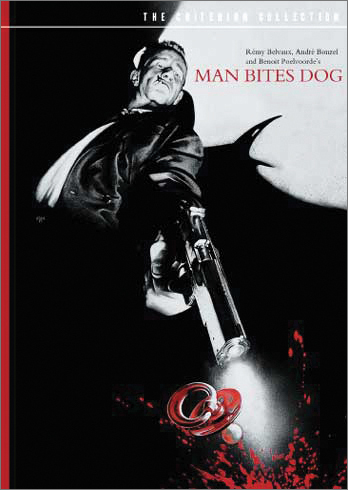
#165: Man Bites Dog


(Rémy Belvaux, André Bonzel, and Benoit Poelvoorde, 1992)

This is the first film I've seen during this project that I actively didn't like. Man Bites Dog is about a crew of documentary filmmakers who follow a serial killer around, learning his thoughts on life and depicting his various murders. My biggest problem with the film is that you can figure out everything the filmmakers are saying - about the media, about violence, about the inherent contradiction in verité film - from that one sentence description of the film.

Most of the references I have seen to Man Bites Dog in the last decade have been praise of its ability to predict the artificial construct of reality television. Yet the themes explored here seem cliché and well-worn even for 1992. The non-stop violence and charming racist aggression the main character displayed were more tiresome than shocking: we've seen it all before, and after all isn't that what the filmmakers are supposed to be telling us in the first place?

Thursday, December 17, 2009

#162: Ratcatcher

(Lynne Ramsay, 1999)

Lyrical, perfectly paced, and deeply moving, Ratcatcher is the kind of film that Criterion has the potential to expose to a wider audience. Lynne Ramsay, who has only made one other movie, the glacially paced and questionably plotted Movern Callar, created with Ratcatcher not just a fascinating depiction of life in Glasgow in the 1970s, when a garbage strike littered the streets with bags of trash, but an immediately recognizable portrait of childhood's resiliency.

I was thinking two things while watching the film. The first was that, like Ballad of a Soldier, Ratcatcher was an essential kind of cinema: the high tourist travelogue. High tourism gives one a sense of the place as it is really lived, as opposed to low tourism, which reinforces the tropes already associated with a place. Ratcatcher, like George Washington, or City of God, or Atarnarjuat, or even the severely flawed Gummo, is a highly stylized but nevertheless authentic depiction of a place in time, one the viewer most likely has never been and most likely will never go. Yet we feel like we have been there after the film, we understand what motivates the people from those places, and finally, we understand that they are a lot like us.

This is the second thing I kept thinking as I was watching the film: as hard as life was for James, the lead character in the film, his attitude and desires didn't seem that different from my own growing up. We all struggle with the same difficulties reconciling our emotions and dreams with the world around us - that's what childhood is at its most basic form. It's not that I had it as hard as James; obviously, that is far from the case, and it would be ridiculous to suggest otherwise. It's that the world we are born into is the only world we know, and it's the inherent resiliency of childhood which makes us all the same. Some of us succumb to our hardships, others rise above them (and depending on your reading of the ending, James might be either of these). But we all go through the same process, the struggle to hold onto the dreams of our youth and build a real life around them.

Looking over comments and essays about the movie, I was not surprised to see that the most talked about scene in the film was the scene of James climbing through the window at the half finished house that his family will most likely never move into and running through a wheat field, basking in the sun. It is the most striking scene not just because of the photography's change in both tone and texture (this is a beautiful film, by the way), but because of the contrast between James sleepwalking through his life and his moments of bliss in the field.

It is another scene that moved me, though. James's friend Kenny takes his mouse and ties him to a balloon in order to let him float up to the moon, and the result calls to mind the earliest moments of imagination in cinema and in childhood, those pristine ideas that everything is going to be different once we learn how to fly.